Compliance guide
NHVAS to HVA transition: Safety management systems, evidence obligations, and what operators must prepare by 1 August 2026
The NHVAS is being progressively replaced by the Heavy Vehicle Accreditation (HVA) scheme from 1 August 2026, introducing mandatory Safety Management Systems and a two-tier accreditation framework. Operators must understand what evidence they need to retain and how CoR duties interact with the new scheme.
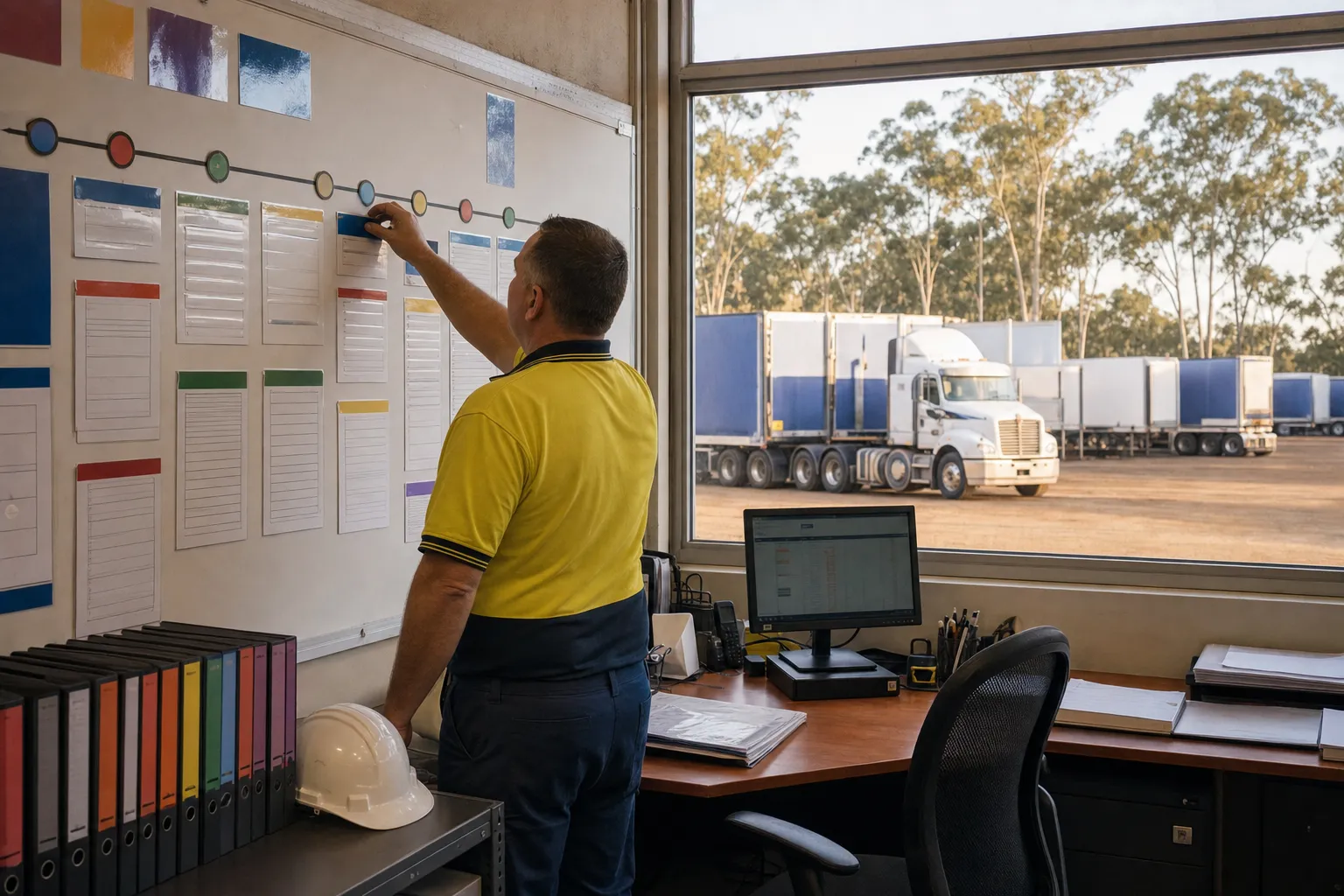
What the NHVAS to HVA transition means for Australian heavy vehicle operators
The National Heavy Vehicle Accreditation Scheme (NHVAS) will be progressively replaced by the Heavy Vehicle Accreditation (HVA) scheme from 1 August 2026, following implementation of amended Heavy Vehicle National Law (HVNL). The HVA introduces a two-tier framework — General Safety Accreditation (GSA) and Alternative Compliance Accreditation (ACA) — and embeds a documented Safety Management System (SMS) as a mandatory requirement for accredited operators. Operators who currently hold NHVAS accreditation, or who plan to seek accreditation, need to understand what changes, what evidence they must produce, and how existing Chain of Responsibility (CoR) duties under the current HVNL connect to the new framework.
Key takeaways
- From 1 August 2026, the NHVAS will progressively transition to the HVA scheme, with new applicants directed to the new framework and existing NHVAS accreditations transitioning over time.
- The HVA requires accredited operators to maintain an effective Safety Management System (SMS) that complies with the NHVR's SMS standard.
- The HVA has two tiers: General Safety Accreditation (GSA), which is the baseline, and Alternative Compliance Accreditation (ACA), which provides regulatory flexibility for operators with mature systems.
- Under the current HVNL, the primary duty in section 26C and the executive duty in section 26D already require operators and their executives to eliminate or minimise risks to safety — the HVA formalises this into an accreditation structure.
- Operators should begin building evidence systems now — covering fatigue management, vehicle maintenance, and CoR controls — so that transition to HVA does not require a scramble to produce documentation.
What is the NHVAS to HVA transition and when does it take effect?
The NHVAS is the current voluntary accreditation scheme administered by the National Heavy Vehicle Regulator (NHVR), allowing operators to demonstrate compliance in areas such as vehicle maintenance, fatigue management, and mass/dimension. From 1 August 2026, the NHVAS will be progressively replaced by the HVA scheme as part of the amended HVNL reforms.
The transition is progressive, meaning existing NHVAS accreditations will not expire overnight. However, new applications for NHVAS accreditation will cease, and operators will be directed to the HVA framework. The NHVR has indicated it will provide transition pathways for existing NHVAS-accredited operators.
The HVA scheme is structured around two tiers:
- General Safety Accreditation (GSA): The baseline accreditation requiring operators to demonstrate they have an effective Safety Management System and meet core safety obligations.
- Alternative Compliance Accreditation (ACA): A higher tier for operators with mature, demonstrably effective safety systems, offering regulatory flexibility such as alternative mass or fatigue limits where supported by their SMS.
This replaces the current NHVAS modules — Mass Management, Maintenance Management, and Fatigue Management — with an integrated, SMS-driven approach.
What does the current HVNL require of operators and CoR duty holders?
Under the current HVNL, all parties in the Chain of Responsibility — including consignors, consignees, packers, loaders, drivers, operators, schedulers, and prime contractors — hold duties to ensure safety. The core obligations are:
- Section 26C (Primary duty): Each party in the CoR must ensure, so far as is reasonably practicable, the safety of transport activities. This includes eliminating or minimising public risk and ensuring vehicles are driven safely and within mass, dimension, and loading requirements.
- Section 26D (Duty of executive of legal entity): Executives of a legal entity that is a party in the CoR must exercise due diligence to ensure the entity complies with its primary duty. This means executives cannot delegate compliance responsibility to operational staff without active oversight.
- Section 26E (Prohibited requests and contracts): No person may make a request or enter a contract that would cause a breach of the HVNL, including inducing a driver to exceed speed limits, work outside fatigue hours, or overload a vehicle.
Breaches are categorised by severity:
- Category 1 offences (section 26F) involve exposure to a risk of death or serious injury and carry the highest penalties.
- Category 2 offences (section 26G) involve a substantial risk.
- Category 3 offences involve less severe but still culpable breaches.
These duties exist today and will continue under the amended HVNL. The HVA transition does not remove or reduce CoR obligations — it layers an accreditation framework on top of them, requiring operators to demonstrate systematic safety management.
What is a Safety Management System and why is it central to HVA?
A Safety Management System (SMS) is a structured, documented approach to managing safety risks across a transport operation. Under the HVA scheme, accredited operators are required to have an effective SMS that complies with the NHVR's SMS standard.
An effective SMS typically includes:
- A documented safety policy and clear safety objectives
- Risk identification and assessment processes covering all transport activities
- Defined responsibilities for managers, drivers, and other CoR parties
- Procedures for incident reporting, investigation, and corrective action
- Vehicle maintenance scheduling and records
- Fatigue management procedures and work diary verification processes
- Training and competency records for drivers and other staff
- Internal audit and review processes to verify ongoing compliance
The shift from NHVAS to HVA means operators can no longer rely on module-by-module compliance — they need an integrated system that demonstrates how safety is managed holistically. This is where many operators will face the steepest learning curve, particularly smaller fleets that have historically managed compliance through informal processes.
For operators looking to understand the SMS requirements in depth, the NHVR provides guidance on Safety Management Systems as part of the HVA transition.
How does Chain of Responsibility fit the new accreditation framework?
Chain of Responsibility obligations under the HVNL remain independent of accreditation status. Whether or not an operator holds HVA accreditation, all CoR parties must comply with their primary duty under section 26C, and executives must meet their due diligence obligation under section 26D.
The HVA scheme does not replace CoR duties — it provides a structured way for operators to demonstrate they are meeting them. An effective SMS, required under HVA, should document how the operator manages its CoR obligations across the supply chain, including:
- How contracts with consignors, consignees, and other parties are structured to avoid prohibited requests under section 26E
- How loading requirements under Part 4.4 of the HVNL are met, including compliance with section 111 and management of minor, substantial, and severe risk breaches (sections 112–114)
- How transport documentation is managed to avoid false or misleading information offences under section 186
- How container weight declarations are verified, given the duty of responsible entities under section 190
The 2026 Master Code, once finalised, will provide practical guidance on how CoR controls should be implemented. Operators preparing for HVA should already be building CoR control documentation that can be integrated into their SMS. For more on turning Master Code controls into daily workflow, see our guide to 2026 Master Code Chain of Responsibility controls and compliance software.
What fatigue management obligations apply under the current HVNL?
Chapter 6 of the HVNL governs driver fatigue. The key obligations include:
- Section 264: Employers, prime contractors, operators, and schedulers must take all reasonable steps to ensure a driver does not breach work and rest hour requirements. This is a positive obligation — it is not enough to simply tell drivers to comply; operators must actively verify compliance.
- Work diary requirements: Drivers operating under Standard Hours, Basic Fatigue Management (BFM), or Advanced Fatigue Management (AFM) must maintain a work diary recording work and rest times. Operators must check and verify these records.
- Categories of breaches: Section 222 of the HVNL defines categories of fatigue breaches, ranging from minor to severe, with corresponding penalty levels.
Under the current NHVAS, operators seeking Fatigue Management accreditation must demonstrate systems for monitoring driver work and rest hours, managing rosters, and verifying work diary compliance. Under the HVA, fatigue management will be integrated into the SMS rather than being a standalone module.
CoRGuard currently supports fatigue and driver diary checks, helping operators verify work diary entries, identify discrepancies, and maintain evidence of active monitoring. An Electronic Work Diary feature is planned but not yet live; until then, operators must rely on manual work diary verification, and CoRGuard provides workflows to support that process.
For more detail on what recent NHVR enforcement signals mean for fatigue compliance, see our analysis of fatigue and driver diary checks and NHVR fatigue checks and operator evidence obligations under the HVNL.
What maintenance evidence do operators need for NHVAS and HVA?
Under the current NHVAS Maintenance Management module, operators must demonstrate a structured vehicle maintenance system including:
- Scheduled maintenance intervals and service records
- Pre-departure checks and daily inspection records
- Defect reporting and rectification logs
- Records of vehicle modifications and approvals
- Evidence that maintenance schedules are actually followed, not just documented
Under the HVA, maintenance management will be absorbed into the SMS. The evidentiary burden will not reduce — if anything, it will increase because auditors will assess maintenance as part of an integrated safety system, not as a standalone module.
Operators transitioning from NHVAS to HVA should audit their current maintenance evidence to identify gaps before the transition. This includes verifying that:
- Maintenance schedules are current and aligned with manufacturer specifications
- Defect reports are being actioned and closed out, with evidence of corrective action
- Pre-departure check records are being completed consistently and retained
- Vehicle inspection records are accessible and linked to specific vehicles
For a deeper guide on maintenance evidence, see our resource on NHVAS to HVA transition: why maintenance evidence needs to be easier to prove and our detailed guide on vehicle maintenance evidence for NHVAS audit readiness and corrective actions.
How will HVA audits differ from current NHVAS audits?
NHVAS audits are currently module-specific — an operator can be audited for Maintenance Management without being audited for Fatigue Management. Under HVA, audits will assess the SMS as a whole, meaning all aspects of the operation will be reviewed in an integrated way.
Key differences operators should expect:
- Integrated audit scope: Auditors will assess whether the SMS is effective across all transport activities, not just whether individual modules are in place.
- Evidence of implementation: It will not be sufficient to have a written SMS — operators must demonstrate it is being followed, with records of training, audits, corrective actions, and management review.
- Risk-based assessment: Auditors will look at how the operator identifies, assesses, and controls risks, and whether the SMS is updated based on incidents, near-misses, and changing conditions.
- Corrective action management: Operators will need to show how corrective actions are identified, assigned, tracked, and closed out, with evidence of effectiveness.
For guidance on maintaining corrective actions and risk registers, see our article on corrective actions and risk registers: the quiet backbone of audit-ready compliance.
How CoRGuard workflows support NHVAS and HVA compliance activity
CoRGuard is the compliance software platform at chainresponsibility.au, designed to help operators build evidence of compliance activity across CoR, fatigue, maintenance, and accreditation requirements. CoRGuard does not guarantee compliance or remove liability — it provides structured workflows that make it easier for operators to demonstrate they are meeting their obligations.
Key CoRGuard capabilities relevant to NHVAS/HVA transition include:
- Fatigue and work diary verification: CoRGuard supports driver diary checks, allowing operators to review work diary entries, identify discrepancies, and record evidence of monitoring activity. This directly supports the section 264 obligation for operators, employers, prime contractors, and schedulers to take all reasonable steps to ensure driver compliance with work and rest hours.
- Maintenance evidence management: CoRGuard workflows help operators track maintenance schedules, log defects and corrective actions, and retain evidence of pre-departure checks and vehicle inspections. This supports both current NHVAS Maintenance Management requirements and future HVA SMS obligations.
- CoR control documentation: CoRGuard provides structured workflows for documenting CoR controls, including contract review, loading compliance, and communication with supply chain parties. This supports compliance with sections 26C–26E of the HVNL and prepares operators for the 2026 Master Code.
- Corrective action tracking: CoRGuard allows operators to log corrective actions, assign responsibility, set due dates, and track closure — creating an auditable trail that demonstrates active safety management.
- Centralised evidence repository: CoRGuard brings compliance evidence into a single platform, reducing the risk of lost or scattered records that can undermine audit readiness.
For operators seeking a structured software approach, CoRGuard's NHVAS compliance software workflows are designed to support both current NHVAS requirements and the transition to HVA.
What should operators do now to prepare for 1 August 2026?
The transition date is fixed. Operators should take practical steps now:
- Audit your current evidence base: Review what maintenance records, fatigue management records, and CoR documentation you currently hold. Identify gaps before the transition, not during an audit.
- Start building your SMS: Begin documenting your safety policy, risk register, and procedures. The SMS does not need to be perfect on day one, but it needs to exist and be in use.
- Strengthen fatigue monitoring: Verify that work diary checks are being performed consistently and that records of those checks are being retained. CoRGuard can support this today.
- Centralise maintenance records: Ensure maintenance schedules, defect reports, and inspection records are in a single, retrievable system. See our guide to audit-ready evidence: what transport operators should centralise before review.
- Review contracts and CoR controls: Check that contracts with consignors, consignees, and other parties do not contain provisions that could constitute prohibited requests under section 26E.
- Engage expert advisory support: For operators needing structured guidance, MAEZ provides expert advisory, training, and chartered risk services to identify gaps and close them. CoRGuard is the software implementation path where ongoing evidence and workflow management are needed.
- Monitor NHVR transition guidance: The NHVR is publishing transition resources, and operators should stay informed about specific timelines and requirements. See the NHVR's NHVAS transition to HVA scheme page for current information.
For a broader view of the 2026 HVNL reforms and what they mean for compliance systems, see our guide to HVNL 2026 reform and transport compliance software: what operators must prepare for by 1 August 2026.
Frequently asked questions
What is the difference between NHVAS and HVA? The NHVAS is the current voluntary accreditation scheme with standalone modules for mass, maintenance, and fatigue management. The HVA, commencing progressively from 1 August 2026, replaces it with a two-tier framework (General Safety Accreditation and Alternative Compliance Accreditation) that requires an integrated Safety Management System covering all aspects of the operation.
Do I need HVA accreditation if I am already NHVAS-accredited? Existing NHVAS accreditations will transition to the HVA scheme progressively. The NHVR has indicated it will provide transition pathways, but operators should prepare by ensuring their documentation and systems meet the SMS standard. Check the NHVR's transition guidance for specific timelines applicable to your accreditation modules.
What is the primary duty under the HVNL? Section 26C of the HVNL imposes a primary duty on each party in the Chain of Responsibility to ensure, so far as is reasonably practicable, the safety of transport activities. This includes eliminating or minimising public risk and ensuring compliance with mass, dimension, loading, speed, and fatigue requirements.
Does CoRGuard guarantee compliance with HVNL or HVA requirements? No. CoRGuard is a compliance software platform that provides workflows to help operators build evidence of compliance activity. It does not guarantee compliance, remove liability, or constitute legal advice. Operators remain responsible for meeting their legal obligations.
Is the Electronic Work Diary available in CoRGuard? The Electronic Work Diary feature is not yet live. CoRGuard currently supports fatigue and driver diary checks, allowing operators to verify work diary entries and retain evidence of monitoring. This supports the section 264 obligation for operators to take reasonable steps to ensure driver compliance.
What is the role of MAEZ in the NHVAS to HVA transition? MAEZ is the expert advisory, training, and chartered risk offering that helps operators identify gaps and build the systems needed for HVA accreditation. CoRGuard at chainresponsibility.au is the SaaS implementation path where software evidence and workflow management are needed on an ongoing basis.
When should I start preparing for the HVA transition? Operators should begin preparing now. The transition commences on 1 August 2026, and building an effective SMS, centralising evidence, and strengthening CoR controls takes time. Starting early reduces the risk of being unable to produce required documentation when audited under the new framework.
Frequently asked questions
Practical answers
- What is the difference between NHVAS and HVA?
- The NHVAS is the current voluntary accreditation scheme with standalone modules for mass, maintenance, and fatigue management. The HVA, commencing progressively from 1 August 2026, replaces it with a two-tier framework (General Safety Accreditation and Alternative Compliance Accreditation) that requires an integrated Safety Management System covering all aspects of the operation.
- Do I need HVA accreditation if I am already NHVAS-accredited?
- Existing NHVAS accreditations will transition to the HVA scheme progressively. The NHVR has indicated it will provide transition pathways, but operators should prepare by ensuring their documentation and systems meet the SMS standard. Check the NHVR's transition guidance for specific timelines applicable to your accreditation modules.
- What is the primary duty under the HVNL?
- Section 26C of the HVNL imposes a primary duty on each party in the Chain of Responsibility to ensure, so far as is reasonably practicable, the safety of transport activities. This includes eliminating or minimising public risk and ensuring compliance with mass, dimension, loading, speed, and fatigue requirements.
- Does CoRGuard guarantee compliance with HVNL or HVA requirements?
- No. CoRGuard is a compliance software platform that provides workflows to help operators build evidence of compliance activity. It does not guarantee compliance, remove liability, or constitute legal advice. Operators remain responsible for meeting their legal obligations.
- Is the Electronic Work Diary available in CoRGuard?
- The Electronic Work Diary feature is not yet live. CoRGuard currently supports fatigue and driver diary checks, allowing operators to verify work diary entries and retain evidence of monitoring. This supports the section 264 obligation for operators to take reasonable steps to ensure driver compliance.
- What is the role of MAEZ in the NHVAS to HVA transition?
- MAEZ is the expert advisory, training, and chartered risk offering that helps operators identify gaps and build the systems needed for HVA accreditation. CoRGuard at chainresponsibility.au is the SaaS implementation path where software evidence and workflow management are needed on an ongoing basis.
- When should I start preparing for the HVA transition?
- Operators should begin preparing now. The transition commences on 1 August 2026, and building an effective SMS, centralising evidence, and strengthening CoR controls takes time. Starting early reduces the risk of being unable to produce required documentation when audited under the new framework.