Compliance guide
NHVAS to HVA transition: why maintenance evidence needs to be easier to prove
The shift from NHVAS to Heavy Vehicle Accreditation in August 2026 raises the bar for how operators prove maintenance compliance. Here is what changes, what the HVNL already requires, and how to make maintenance evidence audit-ready.
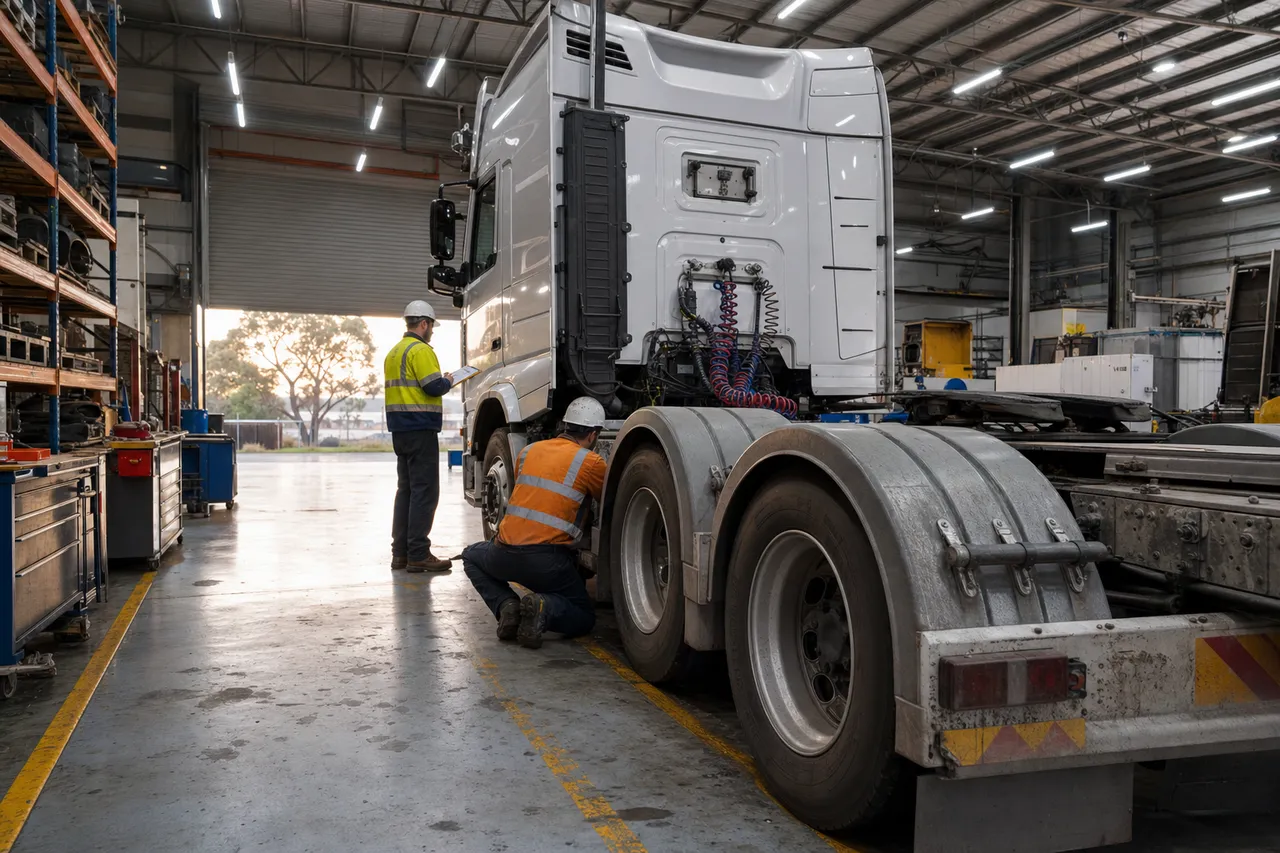
What is the NHVAS to HVA transition and why does maintenance evidence matter?
The National Heavy Vehicle Accreditation Scheme (NHVAS) is being replaced by a new two-tier Heavy Vehicle Accreditation (HVA) framework from 1 August 2026. Under HVA, operators will need to demonstrate robust, evidence-backed maintenance management systems to retain accreditation benefits such as fewer on-road inspections and reduced compliance costs. The transition means that maintenance evidence — the records, inspections, schedules, and corrective actions that prove a vehicle is safe and roadworthy — must be more accessible, more complete, and more defensible under audit than many operators currently maintain.
The Heavy Vehicle National Law (HVNL) already imposes a primary duty on every party in the Chain of Responsibility (CoR) to ensure, so far as is reasonably practicable, the safety of heavy vehicle transport. Maintenance is not a peripheral concern — it sits squarely within that duty. The move to HVA amplifies the evidentiary burden: regulators and auditors will expect structured, retrievable proof that maintenance was planned, performed, verified, and followed up.
Key takeaways
- NHVAS closes to new applicants on 1 August 2026 and is replaced by a two-tier HVA framework comprising General Safety Accreditation (GSA) and Alternative Compliance Accreditation (ACA).
- Maintenance evidence is already required under the HVNL primary duty (s26C) and executive duty (s26D); the HVA transition makes proving that evidence more critical, not less.
- Operators who rely on paper-based or fragmented maintenance records risk being unable to demonstrate compliance during NHVR audits, on-road inspections, or incident investigations.
- Centralising maintenance schedules, inspection records, defect repairs, and corrective actions in a single system makes evidence retrievable on demand — which is what auditors and enforcement officers expect.
- CoRGuard supports maintenance evidence workflows by structuring records, flagging overdue tasks, and producing audit-ready documentation, but it does not guarantee compliance or remove legal liability.
What the HVNL already requires for vehicle maintenance
The Heavy Vehicle National Law (Queensland), which applies as a national law across participating jurisdictions, sets out the legal framework for heavy vehicle safety. While the NHVAS maintenance management module has long been an optional accreditation pathway, the underlying legal obligations apply to every operator regardless of accreditation status.
Under Part 1A.2 of the HVNL, section 26C establishes the primary duty — each party in the CoR must ensure, so far as is reasonably practicable, the safety of heavy vehicle transport activities. This duty is not limited to drivers or operators; it extends to consignors, consignees, packers, loaders, schedulers, and executive officers. Vehicle maintenance falls within this duty because an unsafe or poorly maintained vehicle directly creates risk on the road.
Section 26D imposes a parallel duty on executives of a legal entity — company directors and senior officers must exercise due diligence to ensure the entity complies with its primary duty. For maintenance, this means executives must be able to show they took reasonable steps to ensure vehicles were inspected, defects were identified, and repairs were completed before the vehicle was used.
Breaches of these duties are categorised by severity. Section 26F defines Category 1 offences (the most serious, involving recklessness or gross negligence), and section 26G defines Category 2 offences (serious but without the recklessness element). A failure to maintain vehicles that leads to a serious incident could attract Category 1 or Category 2 liability — and the absence of maintenance records makes it far harder for an operator or executive to demonstrate they took all reasonable steps.
The HVNL also contains specific provisions on vehicle standards (Part 3.2) and modifying heavy vehicles (Part 3.3, sections 84–87A), requiring that vehicles comply with applicable Australian Design Rules and that modifications receive approval from an approved vehicle examiner or the Regulator. These provisions create a direct evidentiary chain: the operator must be able to prove compliance with standards and that any modifications were properly approved.
How does the NHVAS to HVA transition change maintenance evidence requirements?
The NHVAS has existed since the 1990s as a voluntary accreditation scheme that allowed operators to demonstrate robust safety management systems — including a dedicated maintenance management module. Under NHVAS, accredited operators received benefits such as reduced on-road enforcement interventions, recognising that their internal systems provided assurance of compliance.
From 1 August 2026, the NHVAS will be replaced by a new two-tier HVA framework:
- General Safety Accreditation (GSA): A baseline accreditation tier that replaces elements of the existing NHVAS modules. GSA focuses on core safety management practices, including maintenance, fatigue, and mass management.
- Alternative Compliance Accreditation (ACA): A higher tier that provides alternative compliance mechanisms for operators with more mature, evidence-intensive systems.
Under both tiers, maintenance evidence becomes a central plank of accreditation. The shift is not simply a renaming exercise — it reflects a regulatory expectation that operators move beyond paper-based checklists toward integrated, auditable systems that can demonstrate maintenance activity in real time or on demand.
For operators currently holding NHVAS maintenance management accreditation, the transition means existing evidence practices will be reviewed against new HVA standards. Operators who have been maintaining paper service logs, ad-hoc inspection sheets, or disconnected spreadsheets may find that their evidence does not meet the new framework's expectations for completeness, traceability, and timeliness.
Why paper-based maintenance evidence is hard to prove
Many Australian transport operators still rely on paper-based maintenance records — printed service schedules, physical defect cards, and ring-bound inspection logs kept in a workshop office. While these records may capture the fact that maintenance was performed, they have significant weaknesses when it comes to proving compliance:
- Retrieval time: During an NHVR audit or investigation, locating a specific vehicle's maintenance history across months or years of paper records is slow and labour-intensive. Auditors expect timely access.
- Completeness gaps: Paper records are prone to missing pages, illegible entries, and incomplete fields. A missing signature or an undated inspection sheet can undermine the entire evidentiary chain.
- No version control: When a defect is identified and a repair is scheduled, paper systems make it difficult to track whether the repair was completed before the vehicle was dispatched again.
- No linkage to corrective actions: Paper records rarely connect a maintenance defect to a corrective action record, risk register entry, or follow-up verification — all of which are increasingly expected under the HVA framework.
- Vulnerability to loss or damage: Paper records can be lost, damaged, or destroyed, leaving the operator with no evidence if a retrospective investigation occurs.
Under the HVNL primary duty, the question is not just whether maintenance was performed but whether the operator can prove it was performed, that it was timely, and that any defects were addressed. Paper-based systems make that proof fragile.
What does an audit-ready maintenance evidence system look like?
An audit-ready maintenance evidence system should allow an operator to produce, within minutes, a complete picture of any vehicle's maintenance history. This includes:
- Scheduled maintenance plans: A documented maintenance schedule for each vehicle, with due dates based on time, distance, or condition-based triggers.
- Inspection records: Pre-trip, post-trip, periodic, and annual inspection records, with dates, inspector names, and outcomes.
- Defect identification and management: A register of defects found during inspections or reported by drivers, with severity classification, repair deadlines, and verification that the repair was completed.
- Service and repair documentation: Invoices, work orders, and mechanic sign-offs that corroborate that scheduled and unscheduled maintenance was actually performed.
- Corrective action records: When a defect or non-conformance is identified, a linked corrective action record showing what was done, by whom, when, and how it was verified.
- Executive visibility: Reports or dashboards that allow executives to demonstrate due diligence under s26D — showing that maintenance performance is monitored and that systemic issues are identified and addressed.
This is where NHVAS compliance software becomes not just convenient but strategically important. A software-based system centralises these records, applies consistent data structures, and makes evidence retrievable on demand.
How do the HVNL primary duty and executive duty connect to maintenance evidence?
The connection between the HVNL's duty provisions and maintenance evidence is direct. Section 26C imposes the primary duty on each CoR party to ensure safety so far as is reasonably practicable. For an operator, one of the most practicable steps is to maintain vehicles in a roadworthy condition — and to maintain records that prove that maintenance occurred.
Section 26D extends this to executives. Due diligence means more than simply asking whether vehicles are being serviced. It requires executives to have visibility of maintenance performance, to understand where risks exist, and to ensure that systems are in place to manage those risks. A maintenance evidence system that produces reports, flags overdue tasks, and tracks corrective actions gives executives the information they need to discharge their due diligence obligation.
If an incident occurs and a regulator investigates, the operator and its executives will need to demonstrate what they knew, what they did, and when they did it. Disorganised or incomplete maintenance records make it difficult to establish that reasonable steps were taken. Well-structured, timestamped, and retrievable records make it possible to construct a clear narrative of compliance.
For a broader discussion of how the 2026 HVNL changes affect compliance systems more broadly, see What the 2026 HVNL changes mean for transport compliance systems.
GSA and ACA: what each HVA tier means for maintenance evidence
Under the new HVA framework, the two tiers create different evidentiary expectations:
General Safety Accreditation (GSA)
GSA is expected to serve as the baseline accreditation tier. Operators seeking GSA will need to demonstrate that they have structured maintenance management systems in place — including scheduled servicing, inspection regimes, defect management, and record-keeping. The evidence standard for GSA is likely to require:
- Documented maintenance policies and procedures.
- Regular inspection schedules with evidence of completion.
- Defect registers with severity ratings and repair tracking.
- Retention of records for a period sufficient to demonstrate ongoing compliance.
Alternative Compliance Accreditation (ACA)
ACA is designed for operators with more mature systems who seek alternative compliance mechanisms — for example, reduced regulatory intervention in exchange for demonstrating higher levels of assurance. The evidence standard for ACA will be more demanding, likely requiring:
- Integrated, real-time maintenance monitoring.
- Data-driven risk assessment of maintenance performance.
- Documented continuous improvement processes.
- Ability to produce evidence on demand to auditors or the NHVR.
Operators considering which tier to pursue should assess whether their current maintenance evidence practices would meet the GSA baseline. If records are fragmented, manual, or difficult to retrieve, the gap between current practice and HVA expectations needs to be identified and closed before the transition takes effect.
How CoRGuard supports maintenance evidence workflows
CoRGuard is designed to help operators build the kind of structured, retrievable evidence base that the HVA transition demands. While software does not guarantee compliance or remove legal liability, it provides the infrastructure that makes compliance activity practical and defensible.
Key maintenance evidence capabilities in CoRGuard include:
- Centralised maintenance scheduling: Each vehicle's service schedule, inspection intervals, and due dates are stored in a single system, with automated alerts when tasks are overdue.
- Inspection record capture: Pre-trip, post-trip, periodic, and annual inspection records are entered into the system, with structured fields for inspector name, date, vehicle, and outcomes.
- Defect management workflow: When a defect is identified — whether during an inspection or reported by a driver — it is logged with a severity rating, assigned a repair deadline, and tracked through to completion and verification.
- Corrective action linkage: Defects and non-conformances can be linked to corrective action records, ensuring that the full lifecycle of an issue — from identification to resolution to verification — is documented and retrievable.
- Audit-ready reporting: Reports can be generated on demand, showing maintenance history for any vehicle, open defects, overdue tasks, and corrective action status — supporting both NHVR audits and executive due diligence under s26D.
These workflows align with the principles in the 2026 Master Code: turning Chain of Responsibility controls into daily workflow, which emphasises that controls must be embedded in daily operations rather than existing only as documented policies.
For operators looking to understand what evidence to centralise before an audit or accreditation review, Audit-ready evidence: what transport operators should centralise before review provides a practical checklist.
What should operators do now to prepare for the HVA maintenance evidence transition?
The transition date of 1 August 2026 may seem distant, but the work of building an evidence-ready maintenance system takes time — particularly for operators with large fleets, multiple depots, or legacy paper-based systems.
Step 1: Audit your current maintenance evidence
Review what records you currently hold, where they are stored, and how quickly you could produce them if asked by an auditor or investigator. Identify gaps: missing inspection records, untracked defects, or services that were performed but not documented.
Step 2: Map your evidence against HVA expectations
Compare your current evidence practices against what GSA and ACA will require. If your records are paper-based, fragmented, or lack corrective action linkage, those are your priority gaps.
Step 3: Implement a centralised system
Move maintenance scheduling, inspection records, defect management, and corrective actions into a single platform. Chain of Responsibility compliance software like CoRGuard provides the structured workflows needed to make this transition. Explore CoRGuard's features to understand how maintenance evidence fits into a broader CoR compliance framework.
Step 4: Train your team
Maintenance evidence is only as good as the people entering the data. Drivers, workshop staff, fleet managers, and executives all need to understand their role in the evidence chain — from reporting defects to verifying repairs to reviewing reports.
Step 5: Test your evidence before an audit does
Conduct an internal review or mock audit. Ask: can you produce a complete maintenance history for any vehicle in your fleet within 15 minutes? Can you show the link between a defect identified six months ago and its corrective action? Can your executives demonstrate due diligence? If the answer to any of these is no, you have work to do.
For operators who need expert advisory support to assess gaps and build an action plan, MAEZ provides chartered risk advisory, training, and gap-closing services. CoRGuard at chainresponsibility.au is the SaaS implementation path where software evidence is needed.
How corrective actions strengthen maintenance evidence
Corrective actions are the connective tissue of maintenance evidence. A defect identified during an inspection is only the beginning of the evidence chain — the regulator wants to see what happened next. Was the defect assessed for severity? Was the vehicle taken out of service if the defect was critical? Was the repair completed and verified before the vehicle returned to the road?
A structured corrective action process — with records of what was done, by whom, when, and how it was verified — transforms a single-point defect record into a complete compliance narrative. This is why corrective actions and risk registers are described as the quiet backbone of audit-ready compliance.
Under the HVA framework, auditors are likely to look for evidence that corrective actions are not just recorded but actively managed. Overdue corrective actions, unresolved defects, and recurring issues all signal that a maintenance system is not effectively controlling risk — which is precisely what the primary duty requires.
Next steps: making maintenance evidence easier to prove
The transition from NHVAS to HVA is not just a regulatory reshuffle. It is a signal that the NHVR expects operators to move from passive record-keeping to active evidence management. Maintenance is one of the areas where this shift is most consequential, because:
- Maintenance failures can cause catastrophic road incidents, making them a high-priority area for enforcement.
- The primary duty (s26C) and executive duty (s26D) already require operators to demonstrate reasonable steps — and maintenance records are a core part of that demonstration.
- Paper-based or fragmented systems make evidence hard to retrieve, hard to verify, and hard to defend.
- Software-based systems like CoRGuard make it possible to centralise, structure, and retrieve maintenance evidence on demand — but they require implementation, training, and ongoing use to be effective.
If your operation is preparing for the HVA transition, start by assessing your current maintenance evidence, identifying gaps, and implementing a system that can produce audit-ready records when they are needed — not after the fact.
To discuss how CoRGuard can support your maintenance evidence workflows and broader CoR compliance activity, contact the team or review the pricing options available for your operation.
Frequently asked questions
What is the difference between NHVAS and HVA?
NHVAS (National Heavy Vehicle Accreditation Scheme) is the current voluntary accreditation scheme that has operated since the 1990s. HVA (Heavy Vehicle Accreditation) is the new two-tier framework replacing NHVAS from 1 August 2026, comprising General Safety Accreditation (GSA) and Alternative Compliance Accreditation (ACA). The transition raises evidentiary expectations, particularly for maintenance management.
Does the HVNL already require maintenance records even without NHVAS accreditation?
Yes. Under the HVNL primary duty (section 26C), every operator must ensure, so far as is reasonably practicable, the safety of heavy vehicle transport activities. Vehicle maintenance is a core element of that duty. Section 26D extends the obligation to executives, who must exercise due diligence. While the HVNL does not mandate a specific record format, operators must be able to demonstrate that reasonable maintenance steps were taken — which requires evidence.
What happens if I cannot produce maintenance records during an NHVR audit?
If an operator cannot produce maintenance records during an audit or investigation, it becomes significantly harder to demonstrate that the primary duty was discharged. This can lead to findings of non-compliance, suspension or cancellation of accreditation, and potential prosecution under Category 1 or Category 2 offence provisions (ss26F–26G) if the absence of maintenance evidence is linked to a safety incident.
Will CoRGuard guarantee my maintenance compliance under HVA?
No. CoRGuard provides the workflow infrastructure to capture, centralise, and retrieve maintenance evidence, but it does not guarantee compliance or remove legal liability. Compliance depends on how the system is used, whether maintenance is actually performed, and whether the operator and its executives discharge their HVNL duties. CoRGuard supports compliance activity but does not replace the human judgement and operational discipline required.
When does NHVAS close and HVA begin?
NHVAS closes to new applicants on 1 August 2026, at which point the new HVA framework takes effect. Existing NHVAS accreditations will transition to the new framework, but operators should begin preparing their evidence systems well before this date to ensure continuity.
How far back should maintenance records be kept?
While specific retention periods may vary depending on the accreditation module and jurisdictional requirements, operators should maintain maintenance records for a period sufficient to demonstrate ongoing compliance — typically several years. Under audit conditions, the ability to produce historical maintenance records for any vehicle in the fleet is expected. Centralised software systems make long-term retention and retrieval far more practical than paper-based alternatives.
What should I do first to prepare for the HVA maintenance evidence transition?
Start by auditing your current maintenance evidence — identify where records are stored, how quickly they can be retrieved, and whether they link defects to corrective actions. Then assess the gaps against what GSA or ACA will require, and implement a centralised system that can produce audit-ready evidence on demand.
Frequently asked questions
Practical answers
- What is the difference between NHVAS and HVA?
- NHVAS is the current voluntary accreditation scheme operating since the 1990s. HVA is the new two-tier framework replacing NHVAS from 1 August 2026, comprising General Safety Accreditation (GSA) and Alternative Compliance Accreditation (ACA). The transition raises evidentiary expectations for maintenance management and other safety systems.
- Does the HVNL already require maintenance records even without NHVAS accreditation?
- Yes. Under the HVNL primary duty (section 26C), every operator must ensure, so far as is reasonably practicable, the safety of heavy vehicle transport activities. Vehicle maintenance is a core element of that duty. Section 26D extends the obligation to executives, who must exercise due diligence to ensure the entity complies.
- What happens if I cannot produce maintenance records during an NHVR audit?
- Without maintenance records, it is significantly harder to demonstrate that the primary duty was discharged. This can lead to findings of non-compliance, suspension or cancellation of accreditation, and potential prosecution under Category 1 or Category 2 offence provisions (ss26F–26G) if the absence of maintenance evidence is linked to a safety incident.
- Will CoRGuard guarantee my maintenance compliance under HVA?
- No. CoRGuard provides workflow infrastructure to capture, centralise, and retrieve maintenance evidence, but it does not guarantee compliance or remove legal liability. Compliance depends on how the system is used and whether the operator and executives discharge their HVNL duties.
- When does NHVAS close and HVA begin?
- NHVAS closes to new applicants on 1 August 2026, at which point the new HVA framework takes effect. Existing NHVAS accreditations will transition to the new framework, but operators should begin preparing their evidence systems well before this date.
- How far back should maintenance records be kept?
- Operators should maintain maintenance records for a period sufficient to demonstrate ongoing compliance — typically several years. Under audit conditions, the ability to produce historical maintenance records for any vehicle in the fleet is expected. Centralised software systems make long-term retention and retrieval far more practical than paper-based alternatives.
- What should I do first to prepare for the HVA maintenance evidence transition?
- Audit your current maintenance evidence — identify where records are stored, how quickly they can be retrieved, and whether they link defects to corrective actions. Then assess gaps against what GSA or ACA will require, and implement a centralised system that can produce audit-ready evidence on demand.