Compliance guide
Vehicle maintenance evidence for NHVAS audit readiness and corrective actions
Operators must maintain comprehensive vehicle maintenance evidence to pass NHVAS audits and meet HVNL primary duty obligations. Learn what evidence to keep and how to manage corrective actions.
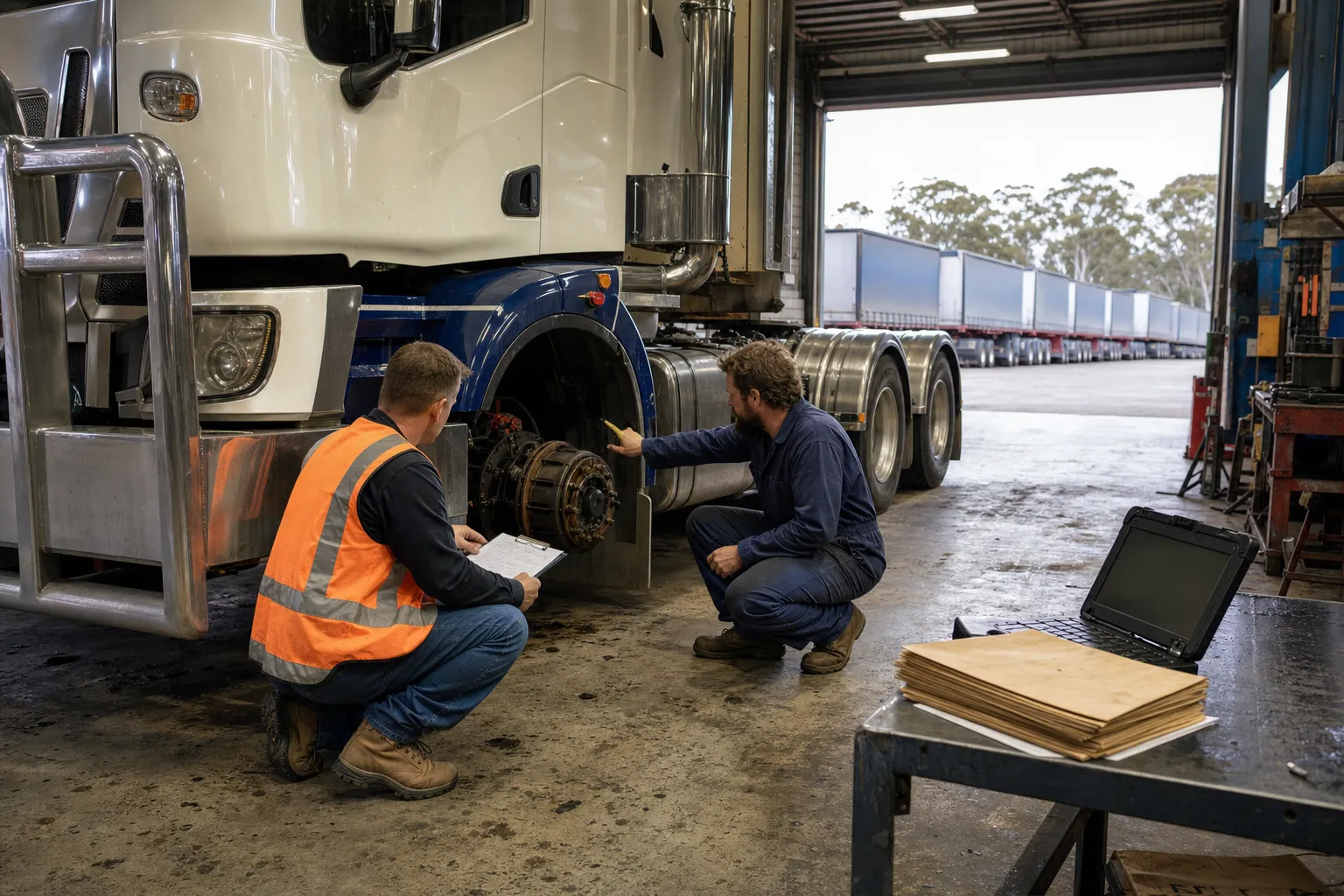
What is NHVAS Maintenance Management accreditation and what evidence does the NHVR require?
NHVAS Maintenance Management accreditation requires heavy vehicle operators to implement a structured system that ensures vehicles are safe and compliant with roadworthiness standards. Under the Heavy Vehicle National Law (HVNL), operators must maintain detailed evidence of daily checks, scheduled servicing, defect management, and repairs. The National Heavy Vehicle Regulator (NHVR) audits this evidence to verify that operators are actively managing vehicle maintenance rather than simply reacting to breakdowns. Accreditation is not a one-time achievement; it requires continuous evidence collection and periodic audits to retain status.
Key takeaways
- NHVAS Maintenance Management accreditation requires documented evidence of daily vehicle checks, scheduled maintenance, defect reporting, and repair records.
- The HVNL primary duty (Part 1A.2, section 26C) places a legal obligation on operators to ensure the safety of vehicles, meaning maintenance failures can trigger Category 1 or Category 2 offences.
- Corrective actions identified during an NHVAS audit must be resolved within specified timeframes to retain accreditation.
- CoRGuard software centralises maintenance evidence, automates defect workflows, and supports audit readiness without guaranteeing compliance.
What does the HVNL primary duty mean for vehicle maintenance?
The HVNL establishes a primary duty of care under Part 1A.2, section 26C. This duty requires all parties in the Chain of Responsibility (CoR)—including operators, drivers, schedulers, and loaders—to ensure the safety of heavy vehicle transport activities. Vehicle maintenance is a core component of this duty. An operator who fails to maintain a vehicle to roadworthiness standards is breaching the primary duty, regardless of whether a crash occurs.
The HVNL also establishes the principle of shared responsibility under section 26A. This means that maintenance obligations do not rest solely on the operator. A consignor who knowingly dispatches a load on an unroadworthy vehicle, or a scheduler who ignores a reported defect to meet a deadline, can also be held liable. Executive officers of a company have a separate duty under section 26D, meaning directors and senior managers must actively ensure the business maintains compliant vehicles.
Operationally, the primary duty means that an operator must have a proactive, documented maintenance system. Reliance on a mechanic’s verbal assurance that a vehicle is “fine” is insufficient. The NHVR expects written records, inspection schedules, and evidence that defects are identified, reported, and rectified before the vehicle returns to service.
How does Chain of Responsibility extend to vehicle maintenance?
Chain of Responsibility laws under the HVNL extend maintenance accountability beyond the operator. Every party who influences vehicle use—including consignors, consignees, packers, loaders, and schedulers—must take reasonable steps to ensure vehicles are roadworthy. For example, a loader who notices a brake defect but proceeds to load the vehicle anyway may be liable under CoR provisions.
This shared responsibility means that maintenance evidence must be accessible to multiple parties. A driver who identifies a defect during a pre-start check must have a clear reporting channel. The operator must record the defect, assess its severity, and determine whether the vehicle can continue safely. If the defect is major or severe, the vehicle must be removed from service immediately. These workflows form the backbone of NHVAS Maintenance Management accreditation and are central to Chain of Responsibility compliance software.
What evidence do operators need to maintain for an NHVAS maintenance audit?
The NHVR requires operators to produce specific, dated, and verifiable evidence during an NHVAS maintenance audit. The NHVAS Maintenance Management Accreditation Guide outlines the categories of evidence an auditor will examine. Operators who cannot produce this evidence face non-conformance findings, which can lead to accreditation loss.
Daily vehicle checks and defect reporting
Drivers must perform daily vehicle checks before operating a heavy vehicle. The operator must retain records of these checks, including the date, vehicle identification, driver name, and any defects identified. Defect reports must classify the defect as minor, major, or severe, consistent with the HVNL’s vehicle standards framework. If a defect is identified, the operator must record the action taken—whether the vehicle was repaired, removed from service, or driven under a defect permit.
CoRGuard supports this workflow by enabling drivers and operators to log daily checks and defects digitally. While CoRGuard does not replace the legal requirement for accurate reporting, it ensures that records are centralised, timestamped, and retrievable during an audit. This is particularly important for operators transitioning from paper-based systems, where lost or illegible forms are a common audit failure point.
Scheduled maintenance and service records
Operators must maintain a documented maintenance schedule for each vehicle in the fleet. This schedule must align with manufacturer recommendations or a risk-based interval determined by the operator’s maintenance policies. The NHVR expects evidence that scheduled services were performed on time and that any overdue services were justified and documented.
The Example of an NHVAS Auditor Report demonstrates the level of detail auditors require. Auditors do not simply confirm that a service occurred; they examine whether the service addressed all scheduled items, whether parts were replaced, and whether the technician was qualified. Operators must retain service worksheets, parts invoices, and mechanic qualifications as supporting evidence.
Repair records and parts traceability
Every repair—whether planned or unplanned—must be documented. The record must include the date of repair, the defect or issue addressed, parts used, the technician’s name and qualification, and the vehicle’s odometer or hour meter reading. Parts traceability is critical because the NHVR may need to verify that a replacement part meets Australian Design Rules (ADRs) or relevant vehicle standards.
CoRGuard’s maintenance module allows operators to attach invoices, service worksheets, and defect reports to individual vehicle profiles. This creates a longitudinal maintenance history for each asset, which is exactly what an NHVAS auditor will request. Operators can also set automated reminders for upcoming services, reducing the risk of overdue maintenance—a common trigger for non-conformance findings.
How do you handle corrective actions identified during an NHVAS audit?
When an NHVAS-approved auditor identifies evidence of non-compliance, they will recommend corrective action. Corrective actions are not optional; they are a formal requirement to retain accreditation. The National Audit Standard makes clear that the resolution of corrective actions from a non-conforming audit is required to retain accreditation.
Corrective actions typically fall into two categories:
-
Documentation gaps: The auditor identifies missing or incomplete records. For example, a daily vehicle check form for a specific date cannot be located, or a service record lacks the technician’s signature. The corrective action requires the operator to produce the missing record or, if it is genuinely lost, to document the loss and implement a process to prevent recurrence.
-
System failures: The auditor identifies a systemic issue in the maintenance management system. For example, scheduled services are consistently overdue, or defect reports are not being actioned within the operator’s stated timeframe. The corrective action requires the operator to review and revise the maintenance policy, retrain staff, and provide evidence that the revised process is working.
Operators must respond to corrective action requests within the timeframe specified by the auditor or the NHVR. This is typically a short window—often 14 to 28 days—though the exact timeframe depends on the severity of the finding. Failure to close out corrective actions within the required period can result in accreditation suspension or cancellation.
CoRGuard supports corrective action management by providing a structured workflow for recording, assigning, and tracking corrective actions. When an auditor raises a finding, the operator can log it in CoRGuard, assign responsibility to a specific staff member, set a due date, and attach supporting evidence once the action is closed. This creates an auditable trail that demonstrates the operator’s commitment to continuous improvement. For a deeper understanding of how corrective actions fit into broader compliance management, see our article on corrective actions and risk registers.
How does CoRGuard software support NHVAS audit readiness and maintenance evidence?
CoRGuard is a compliance SaaS platform designed to help heavy vehicle operators manage their HVNL and NHVAS obligations through structured digital workflows. While CoRGuard does not guarantee compliance or remove legal liability, it significantly reduces the administrative burden of evidence collection and audit preparation.
Key capabilities relevant to NHVAS maintenance audit readiness include:
- Centralised vehicle maintenance records: Every vehicle in the fleet has a digital profile containing service history, defect reports, repair records, and inspection dates. This eliminates the need to search through paper files or spreadsheets during an audit.
- Automated defect workflows: When a driver or operator logs a defect, CoRGuard routes it to the appropriate person for action. The system tracks the defect from identification to resolution, creating a complete evidence chain.
- Service scheduling and reminders: CoRGuard allows operators to set maintenance intervals based on time, distance, or engine hours. Automated reminders alert staff before a service falls due, reducing the risk of overdue maintenance.
- Driver diary and fatigue checks: While CoRGuard’s Electronic Work Diary integration is not yet live, the platform currently supports fatigue and driver diary checks, ensuring that fatigue management evidence is also audit-ready. For more detail, see our NHVR fatigue checks and operator evidence obligations resource.
- Corrective action tracking: Audit findings and internal non-conformances can be logged, assigned, and monitored through to closure, with all supporting evidence attached.
- Document management: Operators can upload and organise maintenance policies, procedures, training records, and external audit reports in a single, searchable repository.
For operators preparing for the transition from NHVAS to the Heavy Vehicle Accreditation (HVA) framework, CoRGuard’s structured evidence management is particularly valuable. The HVA framework will place greater emphasis on Safety Management Systems (SMS), and the maintenance evidence requirements will become more rigorous. To understand what this transition means for your maintenance records, see our guide on the NHVAS to HVA transition and maintenance evidence.
Operators looking to explore the full range of compliance workflows can review CoRGuard’s Features page or learn more about NHVAS compliance software capabilities.
What happens if an operator fails an NHVAS maintenance audit?
If an operator fails an NHVAS maintenance audit, the consequences depend on the severity and nature of the non-conformance. Minor documentation gaps may result in a corrective action request with a specified timeframe for resolution. More serious findings—such as evidence of vehicles operating with known severe defects, or a complete absence of maintenance records—can trigger immediate accreditation suspension.
The NHVR may also refer serious maintenance failures to enforcement teams for investigation under the HVNL. A breach of the primary duty (section 26C) related to vehicle maintenance can result in Category 1 or Category 2 offences, depending on whether the breach exposed the public to a risk of death or serious injury. Category 1 offences carry the highest penalties under the HVNL, including potential imprisonment for individuals.
Loss of NHVAS accreditation also has commercial consequences. Operators may lose access to mass or dimension concessions tied to accreditation, reducing fleet productivity and competitiveness. Customers and consignors may also view lapsed accreditation as a risk indicator, potentially leading to contract losses.
Practical next steps: Building an audit-ready maintenance evidence system
To prepare for NHVAS maintenance audits and meet HVNL primary duty obligations, operators should take the following practical steps:
- Audit your current evidence: Review your existing maintenance records and identify gaps. Are daily checks consistently recorded? Are service worksheets complete and signed? Are defect reports actioned and closed out?
- Centralise your records: Move from paper-based or fragmented digital systems to a single, centralised platform. This ensures that evidence is searchable, retrievable, and protected from loss.
- Implement structured defect workflows: Ensure that every defect—whether identified by a driver, mechanic, or operator—is logged, classified, assigned, and tracked through to resolution.
- Review your maintenance schedule: Confirm that service intervals align with manufacturer recommendations or your documented risk-based policy. Set automated reminders to prevent overdue services.
- Prepare for corrective actions: Before an audit occurs, establish a process for handling corrective action requests. Assign responsibility, set timeframes, and ensure that evidence of resolution is documented.
- Engage expert advisory support: Where gaps are identified, consider engaging MAEZ for expert advisory, training, and risk assessment services. MAEZ provides the strategic guidance and gap-closing support that complements CoRGuard’s software implementation. For operators ready to implement structured compliance workflows, contact CoRGuard to discuss your requirements.
By building a proactive, evidence-based maintenance system, operators can approach NHVAS audits with confidence, demonstrate compliance with HVNL duties, and reduce the risk of enforcement action. For further reading on what evidence to centralise before a review, see our article on audit-ready evidence for transport operators.
Frequently asked questions
Practical answers
- What evidence do I need for an NHVAS Maintenance Management audit?
- You need documented evidence of daily vehicle checks, defect reports and their resolution, scheduled maintenance records (including service worksheets and parts invoices), repair records with technician details, and your maintenance policy and procedures. The NHVR auditor will examine these records to verify that your maintenance system is active, documented, and compliant with HVNL vehicle standards.
- What happens if an NHVAS audit identifies non-compliance?
- The auditor will issue a corrective action request detailing the non-conformance. You must resolve the corrective action within the timeframe specified by the NHVR, typically 14 to 28 days. If corrective actions are not resolved, your NHVAS accreditation may be suspended or cancelled. Serious findings may also be referred to NHVR enforcement for investigation under the HVNL.
- Does the HVNL primary duty apply to vehicle maintenance?
- Yes. Under HVNL Part 1A.2, section 26C, the primary duty requires operators and all CoR parties to ensure the safety of heavy vehicle transport activities. Vehicle maintenance is a core component of this duty. Failing to maintain a roadworthy vehicle is a breach of the primary duty and can result in Category 1 or Category 2 offences depending on the level of risk.
- Can CoRGuard software guarantee I will pass an NHVAS audit?
- No. CoRGuard does not guarantee compliance or remove legal liability. CoRGuard is a SaaS platform that centralises maintenance evidence, automates defect workflows, and supports corrective action tracking. It helps operators build audit-ready systems, but the legal responsibility for compliance remains with the operator and other CoR duty holders.
- How long do I have to close out corrective actions from an NHVAS audit?
- The timeframe for closing out corrective actions is specified by the auditor or the NHVR in the corrective action request. It is typically between 14 and 28 days, though the exact period depends on the severity of the finding. The National Audit Standard requires the resolution of corrective actions from a non-conforming audit to retain accreditation.
- Does CoRGuard support fatigue management as well as maintenance evidence?
- Yes. CoRGuard currently supports fatigue and driver diary checks to help operators manage HVNL Chapter 6 fatigue obligations. An Electronic Work Diary integration is not yet live, but the platform enables operators to record, review, and centralise fatigue management evidence alongside maintenance and other compliance records.
- What is the difference between MAEZ and CoRGuard?
- MAEZ is the expert advisory, training, and chartered risk offering that helps operators identify compliance gaps and build management systems. CoRGuard is the SaaS implementation path at chainresponsibility.au where software evidence and daily compliance workflows are needed. Together, MAEZ provides the strategic guidance and CoRGuard provides the digital tools to support ongoing compliance activity.