Compliance guide
Audit-ready evidence: what transport operators should centralise before review
Australian heavy vehicle operators must centralise fatigue records, maintenance evidence, transport documentation, and CoR duty-holder records before an NHVR or state regulator audit. This guide explains what the HVNL requires and how to structure your evidence.
What does audit-ready evidence mean for Australian transport operators?
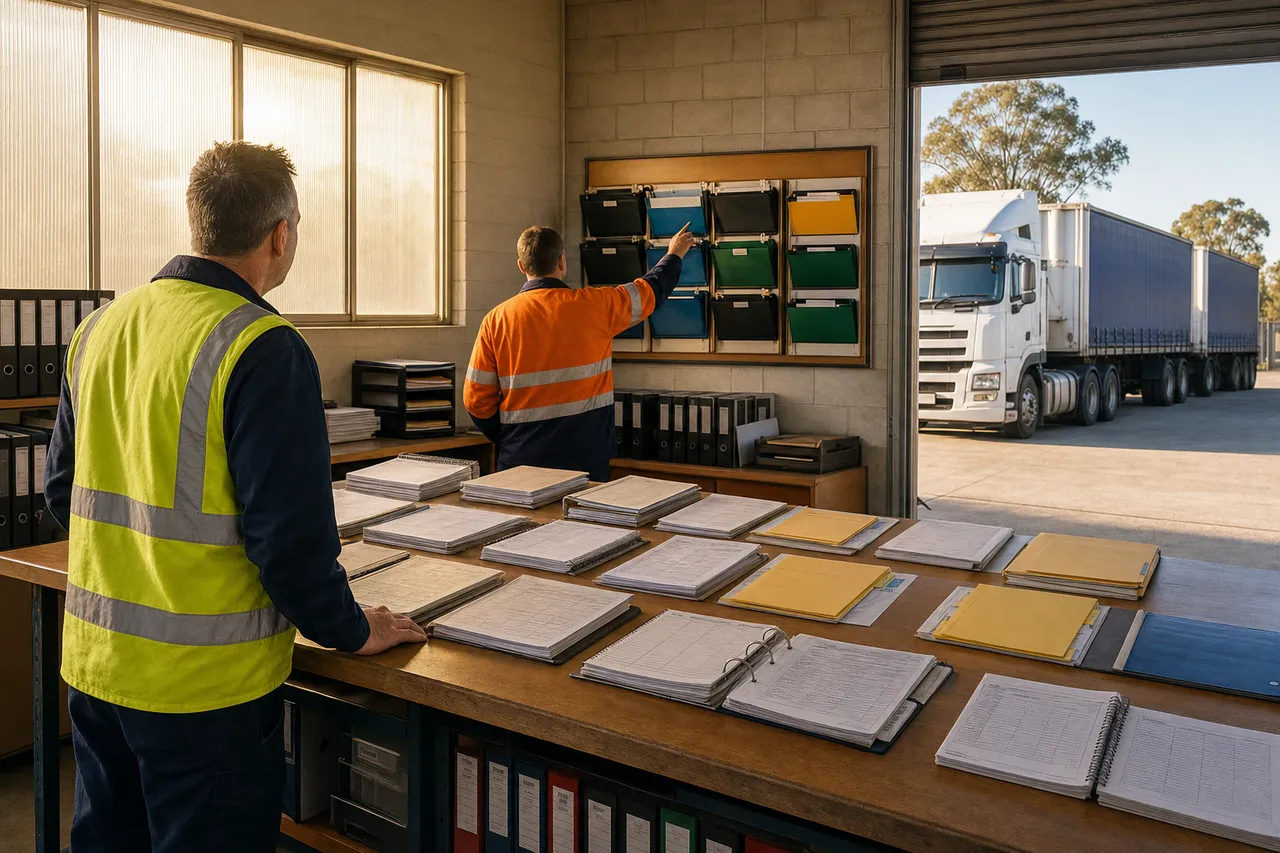
Audit-ready evidence means having every document, record, and workflow artifact a regulator could request—fatigue work diaries, maintenance logs, vehicle accreditation records, driver inductions, and Chain of Responsibility (CoR) duty-holder communications—stored in a centralised, retrievable system before an audit or review occurs. Under the Heavy Vehicle National Law (HVNL), operators, consignors, packers, loaders, and drivers each hold specific duties, and the National Heavy Vehicle Regulator (NHVR) or state road authorities like Queensland's Department of Transport and Main Roads can audit any party in the chain of responsibility to assess compliance. Operators who scramble to reconstruct records after receiving an audit notice face higher risk of gaps, contradictions, and enforcement action.
CoRGuard is built to help operators centralise this evidence systematically, so that compliance activity is supported by structured, time-stamped records rather than ad-hoc document searches.
Key takeaways
- The HVNL imposes a primary duty (section 26C) on each party in the chain of responsibility to eliminate or minimise risks so far as is reasonably practicable. Evidence that this duty is being met must be demonstrable on request.
- Fatigue management records, including work diary entries and driver diary checks, must be retained and centralised. Section 293 of the HVNL requires drivers of fatigue-regulated heavy vehicles to carry a work diary, and sections 294–299 specify the information that must be recorded.
- Heavy vehicle accreditation under the NHVAS framework requires operators to maintain structured maintenance, fatigue, and mass/dimension records. The NHVR can suspend or cancel accreditation under section 474 if evidence is insufficient.
- Transport documentation offences (section 186) and container weight declaration requirements (section 187) mean that false or misleading documentation creates liability for consignors, packers, and operators—centralising these records is essential for audit defence.
- Audit-ready compliance software centralises evidence across fatigue, maintenance, inductions, and corrective actions so that operators can produce records on demand rather than reconstructing them under pressure.
What are the primary CoR duties under the HVNL that require evidence?
The HVNL establishes a framework of shared responsibility across the transport chain. Section 26A sets out the principle of shared responsibility—every party in the chain, from consignor to consignee, bears a duty to prevent breaches. Section 26C imposes the primary duty: each duty holder must ensure, so far as is reasonably practicable, the safety of transport activities relating to a heavy vehicle.
Operationally, this means an operator cannot simply point to another party when a breach occurs. The operator must be able to demonstrate, with evidence, what steps they took to identify, assess, and mitigate risks. This includes:
- Records of inductions and training for drivers, loaders, and schedulers
- Evidence of communication with consignors and consignees about mass, dimension, loading, and fatigue expectations
- Documents showing how schedules were planned to avoid fatigue breaches
- Records of corrective actions taken when issues were identified
Section 26D extends this to executives of legal entities—officers must exercise due diligence to ensure the business complplies with its HVNL duties. This means executives need visibility into the compliance system, not just verbal assurances from managers.
Section 26E addresses prohibited requests and contracts: a party must not make a request or enter a contract that would encourage or require a breach of the HVNL. Evidence of contract terms, dispatch instructions, and scheduling communications should be retained to demonstrate that no party was pressured to breach mass, dimension, or fatigue requirements.
What fatigue records must operators centralise for audit readiness?
Chapter 6 of the HVNL governs vehicle operations and driver fatigue. Operators running fatigue-regulated heavy vehicles must ensure drivers comply with work and rest hour requirements and maintain accurate work diary records.
Key evidence to centralise includes:
- Driver work diary pages—section 293 requires drivers to carry a work diary, and sections 294–299 specify the information that must be recorded, including odometer readings, work and rest times, and location details.
- Driver diary check records—operators must routinely verify that work diary entries are accurate, complete, and consistent with rosters and telematics data. For a detailed breakdown of what NHVR enforcement signals mean for operators, see our resource on fatigue and driver diary checks.
- Roster and schedule records showing that dispatch decisions did not create fatigue pressure.
- Fatigue management system documentation—if operating under Basic Fatigue Management (BFM) or Advanced Fatigue Management (AFM), accreditation records and compliance evidence must be current and accessible.
- Odometer malfunction notifications—section 399 requires employers or operators to take specific actions when an odometer is malfunctioning, and records of these actions must be retained.
CoRGuard's current capability supports fatigue and driver diary checks through structured workflows. Our Electronic Work Diary feature is not yet live, but the existing driver diary check functionality helps operators verify and record diary compliance systematically.
What maintenance and vehicle accreditation evidence is needed?
Operators accredited under the National Heavy Vehicle Accreditation Scheme (NHVAS) must maintain structured maintenance records to demonstrate that vehicles are safe and compliant. The NHVR can audit accredited operators at any time, and section 473 allows the Regulator to amend, suspend, or cancel accreditation on its own initiative if the operator fails to maintain standards.
Section 474 provides for immediate suspension of heavy vehicle accreditation where there is a serious risk to safety. This means that gaps in maintenance evidence can result in immediate operational disruption, not just a corrective action notice.
Maintenance evidence to centralise includes:
- Vehicle service and inspection records with dates, items checked, defects identified, and actions taken
- Defect repair records showing when faults were identified and when they were rectified
- Pre-departure check records completed by drivers
- Maintenance schedules aligned with NHVAS requirements or the operator's accredited management system
- Evidence of periodic maintenance for vehicles transitioning from NHVAS to the new Heavy Vehicle Accreditation (HVA) framework—see our guide on NHVAS to HVA transition and maintenance evidence.
What transport documentation and container weight declarations must be retained?
Section 186 of the HVNL creates an offence for false or misleading transport documentation for goods. This means any party in the chain—consignor, packer, loader, or operator—who provides false or misleading information in transport documentation commits an offence. The records must be accurate and retained.
Section 187 specifically addresses false or misleading information in container weight declarations. Operators handling containerised freight must ensure that container weight declarations are accurate and compliant, and these declarations must be stored as evidence.
Evidence to centralise:
- Consignment notes and transport documentation for each movement
- Container weight declarations where applicable
- Loading instructions and mass/dimension declarations
- Records showing that documentation was reviewed for accuracy before dispatch
- Communications with consignors, packers, and loaders about mass and dimension limits
How does the NHVAS accreditation framework interact with audit evidence?
NHVAS accreditation provides a structured framework for operators to demonstrate compliance in three key modules: Mass Management, Maintenance Management, and Fatigue Management. Accreditation under NHVAS requires operators to maintain documented systems and records that can be audited by the NHVR or an approved third-party auditor.
Section 470 sets out the requirements applying to operators with heavy vehicle accreditation—operators must comply with the conditions of their accreditation and maintain the records specified under the scheme. Section 471 requires operators to give notice of any amendment, suspension, or ending of accreditation.
For operators using software to manage NHVAS compliance, the key is that records must be not only maintained but retrievable on demand. An auditor will request specific evidence—service records for a particular vehicle, work diary checks for a particular driver, or mass management records for a particular consignment—and the system must produce these quickly. Our NHVAS compliance software page explains how CoRGuard structures this evidence.
What role does the Master Code play in structuring compliance evidence?
The Master Code is an industry code of practice under the HVNL that provides practical guidance on how parties in the chain of responsibility can comply with their primary duty. It outlines specific controls and practices for each role—consignor, consignee, packer, loader, driver, and operator—and provides a benchmark for what a court or regulator may consider reasonable.
The Master Code is particularly relevant for audit preparation because it gives operators a structured checklist of the controls and evidence expected for each CoR party. By aligning internal systems with the Master Code, operators can ensure their evidence covers the areas a regulator is likely to examine.
Key Master Code evidence areas include:
- Documented CoR policies and procedures for each party in the chain
- Records of inductions and training aligned with role-specific responsibilities
- Evidence of regular reviews and updates to CoR systems
- Corrective action registers showing how identified gaps were addressed
- Risk assessment records demonstrating proactive identification of transport safety risks
For a deeper explanation of how the Master Code translates into daily workflow, see our resource on the 2026 Master Code and CoR controls.
How does audit-ready compliance software centralise fleet compliance management?
Fleet compliance management requires operators to track multiple data streams simultaneously—driver fatigue records, vehicle maintenance, CoR documentation, inductions, and corrective actions. When these records are spread across spreadsheets, shared drives, paper files, and individual email inboxes, audit preparation becomes a reconstruction exercise rather than a retrieval exercise.
Audit-ready compliance software like CoRGuard centralises this evidence by:
- Structuring data capture so that records are created at the point of activity—driver diary checks are logged when completed, maintenance tasks are recorded when actioned, and inductions are documented when delivered.
- Time-stamping evidence so that each record has an auditable creation date, supporting the integrity of the evidence.
- Linking records to vehicles, drivers, and journeys so that an auditor can trace the full compliance picture for any specific incident or period.
- Tracking corrective actions from identification to closure, with evidence of what was done, when, and by whom. Our guide on corrective actions and risk registers explains how this backbone supports audit readiness.
- Providing a single source of truth so that all parties—operators, managers, and auditors—are looking at the same data.
CoRGuard's Features page provides an overview of how these workflows function in practice. The platform does not guarantee compliance or remove liability, but it provides the structured evidence base that operators need to demonstrate their compliance activity.
What happens during an NHVR or state regulator audit?
When the NHVR or a state road authority such as Queensland's Department of Transport and Main Roads conducts an audit, they assess whether each party in the chain of responsibility is meeting its HVNL duties. The auditor will typically request:
- Fatigue management records, including work diaries, roster records, and driver diary check evidence
- Maintenance records for specific vehicles, including service histories and defect management
- Transport documentation, including consignment notes and container weight declarations
- CoR system documentation, including policies, procedures, inductions, and training records
- Corrective action registers and evidence of continuous improvement
- NHVAS accreditation records and evidence of compliance with accreditation conditions
Auditors may focus on a specific incident—a fatigue breach, a mass overload, or a maintenance defect—and trace the evidence chain backward to identify where the system failed and which party bears responsibility. Operators with centralised, time-stamped evidence can demonstrate what they did, when they did it, and why it was reasonable in the circumstances. Operators without this evidence face a presumption that adequate systems were not in place.
The Queensland Department of Transport and Main Roads can audit any person in the chain of responsibility to assess compliance with relevant transport laws, as noted in their published guidance on chain of responsibility.
Practical next steps: how CoRGuard supports audit-ready evidence
CoRGuard is the SaaS implementation path for operators who need software-backed evidence of their compliance activity. The platform supports audit readiness through structured workflows across the key evidence areas:
- Fatigue and driver diary checks—centralise work diary verification, roster cross-checking, and fatigue breach identification. (Note: the Electronic Work Diary feature is not yet live; current capability focuses on driver diary checks.)
- Maintenance and NHVAS/HVA evidence—structure vehicle service records, defect management, and accreditation-aligned maintenance workflows.
- CoR documentation—store and retrieve transport documentation, container weight declarations, and communications with chain parties.
- Inductions and training—document role-specific inductions aligned with Master Code expectations for each CoR party.
- Corrective actions and risk registers—track identified gaps through to closure with auditable evidence of each step.
For operators who need expert advisory support—chartered risk assessments, gap analysis, training, or compliance strategy—MAEZ provides the expert advisory layer, while CoRGuard at chainresponsibility.au provides the software implementation path where structured evidence is needed.
To explore how CoRGuard can support your audit readiness, visit our Use Cases page or Contact us to discuss your specific compliance profile. You can also review our Resources library for additional guides on HVNL, fatigue, maintenance, and CoR compliance.
What should operators do right now to prepare for an audit?
Start by conducting an internal evidence audit. Identify which records you currently hold, where they are stored, and how quickly you could retrieve them if requested. Then map these against the HVNL duties and NHVAS accreditation requirements that apply to your operation. The gaps you identify are your priority corrective actions.
If your records are scattered across multiple systems or paper files, centralising them into a structured platform like CoRGuard is the most efficient path to audit readiness. If you need expert guidance on what your evidence gaps mean and how to close them, MAEZ provides the advisory and training support to bridge the gap between your current state and audit-ready compliance.
For forward planning, note that HVNL amendments are due to take effect on 1 August 2026. Our resource on what the 2026 HVNL changes mean for transport compliance systems outlines what operators should anticipate.
Frequently asked questions
What records must a heavy vehicle operator keep for NHVR audit?
A heavy vehicle operator must keep fatigue management records (including driver work diaries and driver diary check records), vehicle maintenance and defect management records, transport documentation (including consignment notes and container weight declarations), CoR policy and induction records, corrective action registers, and NHVAS accreditation records. The HVNL sections 26C (primary duty), 293 (work diary requirements), 186 (transport documentation), and 470 (accreditation requirements) are among the key provisions that define what evidence is needed.
How long should transport compliance records be retained?
The HVNL and its associated regulations specify retention periods for various record types. Operators should retain fatigue management records, maintenance records, and transport documentation for the periods required under the HVNL and NHVAS accreditation conditions. As a practical matter, records should be retained for at least the period specified by the NHVR for the relevant module, and operators should consult the current regulations or seek expert advice for specific timeframes.
Does using compliance software guarantee HVNL compliance?
No. Compliance software does not guarantee compliance or remove liability. The HVNL imposes duties on each party in the chain of responsibility, and compliance depends on the actions taken by those parties, not solely on the software used. CoRGuard provides structured workflows and evidence capture that support compliance activity, but duty holders remain responsible for meeting their obligations under the law.
What is the difference between NHVAS and the new HVA framework?
NHVAS (National Heavy Vehicle Accreditation Scheme) is the current accreditation framework administered by the NHVR, covering mass management, maintenance management, and fatigue management modules. The Heavy Vehicle Accreditation (HVA) framework represents the transition path for operators. The transition affects how maintenance and compliance evidence is structured and reported. See our guide on NHVAS to HVA transition for details.
What is the executive due diligence duty under the HVNL?
Section 26D of the HVNL imposes a duty on executives of legal entities to exercise due diligence to ensure the business complplies with its HVNL duties. This means executives must have visibility into the compliance system, understand the risks, and take reasonable steps to ensure adequate controls are in place. Audit-ready evidence supports executives in demonstrating that due diligence has been exercised.
Can the NHVR suspend accreditation immediately?
Yes. Section 474 of the HVNL provides for immediate suspension of heavy vehicle accreditation where the Regulator believes there is a serious risk to safety. This means that significant gaps in maintenance, fatigue, or mass management evidence can result in immediate operational consequences, not just a corrective action notice.
What is the Master Code and how does it relate to audit evidence?
The Master Code is an industry code of practice under the HVNL that provides practical guidance on how CoR parties can comply with their primary duty. It outlines specific controls for each role in the chain—consignor, consignee, packer, loader, driver, and operator. Aligning internal systems with the Master Code gives operators a structured framework for the evidence a regulator or court may expect to see.
Frequently asked questions
Practical answers
- What records must a heavy vehicle operator keep for NHVR audit?
- A heavy vehicle operator must keep fatigue management records (including driver work diaries and driver diary check records), vehicle maintenance and defect management records, transport documentation (including consignment notes and container weight declarations), CoR policy and induction records, corrective action registers, and NHVAS accreditation records. The HVNL sections 26C (primary duty), 293 (work diary requirements), 186 (transport documentation), and 470 (accreditation requirements) are among the key provisions that define what evidence is needed.
- Does using compliance software guarantee HVNL compliance?
- No. Compliance software does not guarantee compliance or remove liability. The HVNL imposes duties on each party in the chain of responsibility, and compliance depends on the actions taken by those parties. CoRGuard provides structured workflows and evidence capture that support compliance activity, but duty holders remain responsible for meeting their obligations under the law.
- What is the executive due diligence duty under the HVNL?
- Section 26D of the HVNL imposes a duty on executives of legal entities to exercise due diligence to ensure the business complies with its HVNL duties. Executives must have visibility into the compliance system, understand the risks, and take reasonable steps to ensure adequate controls are in place. Audit-ready evidence supports executives in demonstrating that due diligence has been exercised.
- Can the NHVR suspend accreditation immediately?
- Yes. Section 474 of the HVNL provides for immediate suspension of heavy vehicle accreditation where the Regulator believes there is a serious risk to safety. Significant gaps in maintenance, fatigue, or mass management evidence can result in immediate operational consequences, not just a corrective action notice.
- What is the Master Code and how does it relate to audit evidence?
- The Master Code is an industry code of practice under the HVNL that provides practical guidance on how CoR parties can comply with their primary duty. It outlines specific controls for each role in the chain—consignor, consignee, packer, loader, driver, and operator. Aligning internal systems with the Master Code gives operators a structured framework for the evidence a regulator or court may expect to see.
- What is the difference between NHVAS and the new HVA framework?
- NHVAS (National Heavy Vehicle Accreditation Scheme) is the current accreditation framework administered by the NHVR, covering mass management, maintenance management, and fatigue management modules. The Heavy Vehicle Accreditation (HVA) framework represents the transition path for operators, affecting how maintenance and compliance evidence is structured and reported.
- Is CoRGuard's Electronic Work Diary feature available?
- The Electronic Work Diary feature is not yet live. CoRGuard's current fatigue capability focuses on driver diary checks—verifying that work diary entries are accurate, complete, and consistent with rosters and telematics data. This supports operators in meeting their fatigue management evidence obligations under Chapter 6 of the HVNL.