MAEZ guide
Chain of Responsibility Training for Executives and Managers: A Practical Guide for Australian Transport Operators
Chain of Responsibility training equips executives and managers with the knowledge to discharge their personal HVNL duties, reduce exposure to Category 1 and 2 offences, and build a defensible Safety Management System that holds up under NHVR scrutiny.
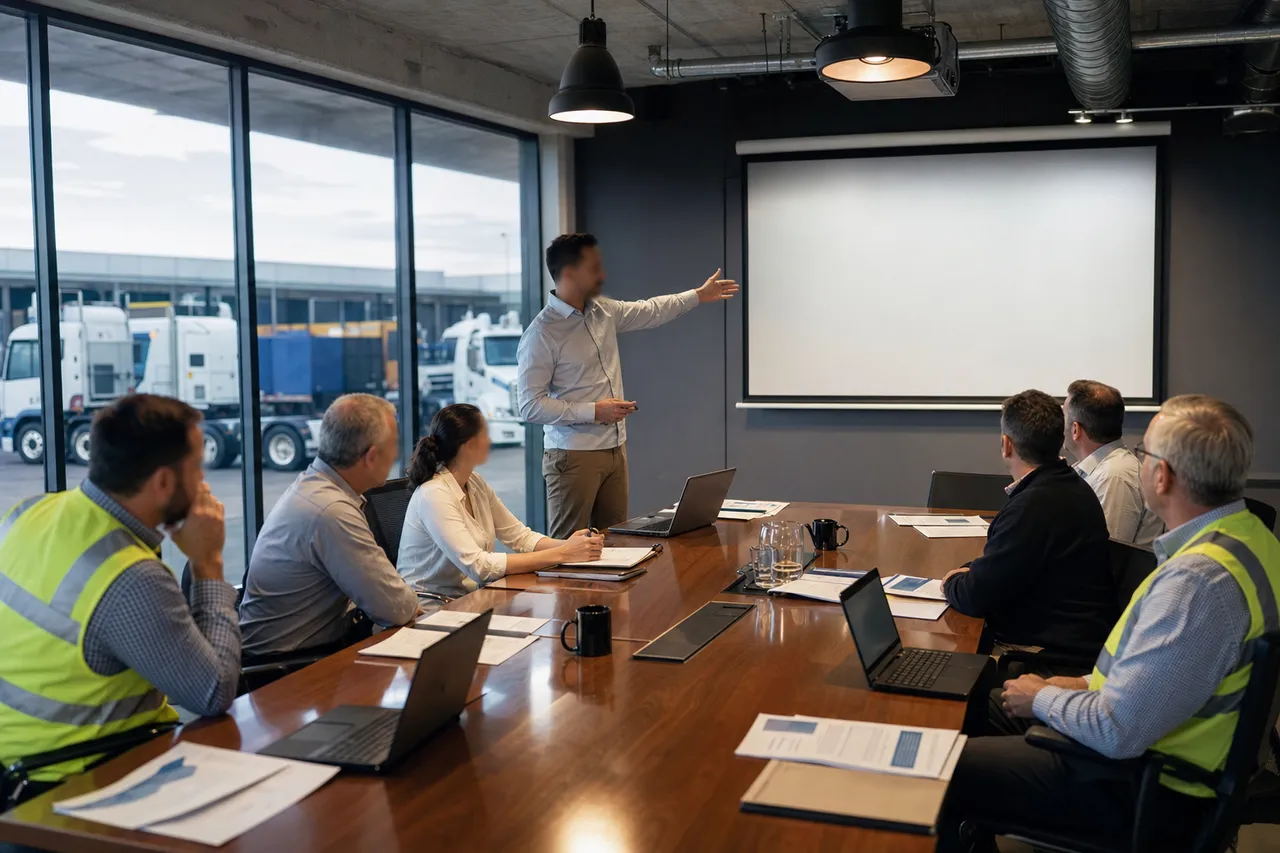
What Is Chain of Responsibility Training and Why Do Executives Need It?
Chain of Responsibility training is structured education that teaches executives, managers, and other duty holders how to identify, manage, and eliminate heavy vehicle safety risks across the transport supply chain. Under the Heavy Vehicle National Law (HVNL), responsibility for heavy vehicle safety is shared across every party who influences transport activity — not just the driver. Executives and senior managers carry personal duties under section 26D of the HVNL, which means they can be held individually liable for breaches even when the company is also charged. Training is the mechanism by which leaders understand what the law requires of them, what evidence they need to demonstrate compliance, and how to build systems that prevent breaches before they happen.
For Australian transport operators, Chain of Responsibility Training for Australian Operators is not a box-ticking exercise. It is the foundation of a defensible position against fines, licence suspensions, and reputational damage. MAEZ helps operators stop losing sleep over fines, accreditation risk, and scattered evidence by pairing expert advisory with practical training pathways and the CoRGuard SaaS platform for Safety Management System evidence management.
Key Takeaways
- Executives have personal duties under HVNL section 26D. A director or executive officer who knows — or ought reasonably to know — that the business is breaching heavy vehicle safety duties and fails to act commits an offence personally, separate from the company's liability.
- The HVNL principle of shared responsibility (section 26A) extends to every party in the supply chain. Consignors, packers, loaders, schedulers, operators, and consignees all hold duties proportional to their ability to control transport risks.
- Category 1 and Category 2 offences carry the most severe penalties. Category 1 applies where a person knowingly breaches a duty or is reckless about substantial harm. Category 2 applies where the breach exposes an individual to a risk of death or serious injury.
- Training is evidence. Documented CoR training for executives, managers, and staff is one of the most powerful pieces of evidence an operator can produce during an NHVR investigation or NHVAS audit.
- CoRGuard is the SaaS platform that stores your training records, policies, and SMS evidence in one place. It does not replace the obligation to comply, but it gives you the evidence architecture to demonstrate what you have done.
What Does the HVNL Actually Require of Executives and Managers?
The Primary Duty (Section 26C)
The HVNL imposes a primary duty on each party in the chain of responsibility to ensure, so far as is reasonably practicable, the safety of transport activities. This duty covers vehicle mass, loading, speed, fatigue, and vehicle standards. For executives and managers, the primary duty means you must actively ensure that the business has systems, policies, and procedures that prevent breaches — not merely react to them after they occur.
The Executive Duty (Section 26D)
Section 26D of the HVNL places a direct, personal duty on executives of legal entities. An executive must exercise due diligence to ensure the business complies with its safety duties. This means the executive must:
- Acquire and keep up to date with knowledge of heavy vehicle safety matters
- Understand the nature of the business's transport operations and the risks associated with them
- Ensure the business has appropriate resources and processes to eliminate or minimise risks
- Ensure the business has appropriate processes for receiving and responding to information about incidents, hazards, and risks
- Ensure the business implements processes for complying with its duties
This is not a passive obligation. An executive who cannot demonstrate due diligence — for example, by showing they completed Chain of Responsibility Course training, reviewed safety data, and directed changes — is exposed to personal prosecution.
Prohibited Requests and Contracts (Section 26E)
Section 26E makes it an offence to request, direct, or enter a contract that induces another party to breach the HVNL. For managers, this means you cannot schedule a delivery in a timeframe that requires a driver to speed or exceed work hours. You cannot accept a load that you know — or should know — is over mass limits. Training helps managers recognise these situations and gives them the language and authority to push back.
Who Are the Chain of Responsibility Duty Holders?
The HVNL defines multiple parties in the chain, each with duties proportional to their role and control. Chain of Responsibilities: What Australian HVNL Duty Holders Need to Understand provides a detailed breakdown, but the core parties are:
- Consignor: The person or business that engages a carrier to transport goods. They must ensure the goods are fit for transport and that mass and loading requirements can be met.
- Consignee: The person or business that receives the goods. They must not place demands on the transport task that create unreasonable time pressures.
- Packer: The person who packs or loads goods into a container or onto a vehicle. They must ensure the load is distributed correctly and within mass limits.
- Loader: The person who loads goods onto a heavy vehicle. They are responsible for load restraint, mass distribution, and dimension compliance.
- Driver: The person driving the heavy vehicle. They must comply with work and rest hours, speed limits, and vehicle standards.
- Operator: The person or business that operates the heavy vehicle. They must maintain the vehicle, manage fatigue, and ensure scheduling does not create breaches.
- Scheduler: The person who plans routes and schedules. They must ensure schedules allow drivers to comply with work and rest hours.
Executives and managers may hold multiple roles simultaneously. A transport manager who schedules deliveries, manages vehicle maintenance, and supervises drivers is a scheduler, an operator representative, and potentially a loader — all at once. Training helps individuals understand which duties apply to them in which contexts.
What Are Category 1 and Category 2 Offences Under the HVNL?
The HVNL classifies breaches into categories based on the level of culpability and risk:
- Category 1 offence (section 26F): Applies where a person knowingly breaches a duty or is reckless about whether the breach would cause substantial harm. This is the most serious category and carries the highest penalties, including potential imprisonment for individuals.
- Category 2 offence (section 26G): Applies where a person's breach of duty exposes an individual to a risk of death or serious injury or illness. This is a significant offence with substantial penalties.
- Category 3 and Category 4 offences: Lower-level breaches, typically involving failures to comply with specific requirements without immediate risk of harm.
For executives, the critical point is that ignorance is not a defence. Section 632 of the HVNL addresses whether a person ought reasonably to have known something — meaning the regulator can argue that an executive should have known about a risk if they had been exercising due diligence. This is why documented training is essential: it demonstrates that the executive took active steps to understand and manage their obligations.
How Does CoR Training Connect to NHVAS Accreditation?
NHVAS (National Heavy Vehicle Accreditation Scheme) accreditation is a voluntary scheme administered by the NHVR that allows operators to demonstrate compliance in key areas: mass management, maintenance management, fatigue management, and basic fatigue management. Under NHVAS, operators must maintain a documented management system that includes policies, procedures, records, and training.
CoR training is a foundational element of NHVAS accreditation because it provides the knowledge base that underpins every module. For example:
- Mass management requires loaders and schedulers to understand mass limits and load distribution — topics covered in CoR training.
- Maintenance management requires operators to have systems for vehicle inspection and defect management — which CoR training addresses from a duty-holder perspective.
- Fatigue management requires schedulers and managers to understand work and rest hour requirements and the consequences of scheduling breaches — a core CoR training topic.
Without documented training, an NHVAS audit will struggle to find evidence that staff and management understand their obligations. Training records are one of the first things an auditor will request.
How Does CoR Training Support a Safety Management System?
A Safety Management System (SMS) is a structured approach to managing safety risks across your transport operations. Under the NHVAS Master Code and broader HVNL expectations, an SMS should include:
- Identified hazards and risks
- Controls and mitigation strategies
- Defined responsibilities for each role
- Training and competency records
- Incident reporting and investigation processes
- Continuous improvement mechanisms
CoR training is the mechanism by which an SMS becomes operational. An SMS document on a shelf is not a system — it is a document. When every manager, scheduler, loader, and driver has been trained on their specific duties, the SMS becomes a living framework that drives daily decision-making. Chain of Responsibility Consulting can help you design an SMS that aligns with your actual operations rather than a generic template.
What Should CoR Training for Executives and Managers Cover?
Effective Chain of Responsibility training for executives and managers should cover:
- The legal framework: HVNL structure, key sections (26A–26E, 26F–26G, 636), and how duties apply to each party in the chain.
- Due diligence obligations: What section 26D requires of executives and how to document due diligence activities.
- Prohibited requests and contracts: How section 26E applies to scheduling, contracting, and customer demands.
- Risk identification and management: How to identify heavy vehicle safety risks in your specific operations and implement controls.
- Mass, loading, and dimension: Practical understanding of mass limits, load restraint, and dimension requirements.
- Fatigue management: Work and rest hour requirements, work diary obligations, and scheduling responsibilities.
- Speed and vehicle standards: How operator and driver duties apply to speed compliance and vehicle maintenance.
- Incident response: What to do when a breach occurs, how to investigate, and how to document corrective actions.
- Evidence and documentation: What records you need to keep, for how long, and how to organise them for audit readiness.
- Executive liability: Personal exposure under section 26D and section 636, and how to protect yourself and your business.
Training should be role-specific. A driver needs different training from a scheduler, who needs different training from an executive. Generic, one-size-fits-all training may tick a box but will not provide the targeted knowledge that each duty holder needs.
How Do You Build Evidence That Training Actually Happened?
Training is only valuable as evidence if it is documented. The NHVR and NHVAS auditors look for:
- Training plans: A documented schedule of who needs training, what type, and when it is due.
- Attendance records: Signed registers or digital records showing who attended and when.
- Assessment results: Evidence that participants understood the material — quizzes, practical demonstrations, or supervisor sign-off.
- Currency: Records showing refresher training at appropriate intervals.
- Role-specific content: Evidence that training was tailored to the participant's actual duties.
This is where the CoRGuard SaaS platform becomes critical. CoRGuard, available at chainresponsibility.au, is the SaaS implementation path where software evidence is needed. It allows operators to store training records, policies, procedures, and SMS documentation in a structured, auditable format. CoRGuard does not remove liability or guarantee compliance — no software can — but it gives you the evidence architecture to demonstrate what you have done and when.
MAEZ provides the advisory and Using a Chartered Risk Lens to Close Chain of Responsibility Gaps in Australian Transport gap-closing expertise to design the training program, identify gaps, and build the SMS. CoRGuard provides the platform to hold the evidence. Together, they give you a system that is defensible, organised, and ready for any NHVR investigation or NHVAS audit.
How Often Should CoR Training Be Refreshed?
There is no single statutory frequency for CoR training refreshers under the HVNL. However, the NHVAS Master Code and general due diligence principles require that training be kept current. Best practice for Australian transport operators includes:
- Initial training for all new staff and executives before they commence transport-related duties.
- Annual refresher training for all duty holders, covering changes to legislation, business operations, or identified risk areas.
- Incident-triggered training following any breach, near-miss, or regulatory intervention, focused on the specific area of failure.
- Legislative update training whenever the HVNL or relevant regulations change.
Note that HVNL updates due 1 August 2026 are future-effective until that date. Operators should plan for training updates ahead of legislative changes rather than waiting until they take effect.
What Are the Consequences of Not Training Your Team?
The consequences of failing to train executives, managers, and staff on Chain of Responsibility duties include:
- Personal prosecution of executives under section 26D for failing to exercise due diligence.
- Corporate prosecution under section 636, which addresses liability of executive officers of corporations.
- Category 1 or 2 charges where the breach involves knowledge or recklessness.
- Loss of NHVAS accreditation where training records are insufficient or absent.
- Inability to demonstrate due diligence in an NHVR investigation, leading to higher penalties or enforcement action.
- Insurance and contract impacts where customers or insurers require evidence of CoR compliance.
The regulator's position is clear: if you cannot show that you trained your people, you cannot demonstrate that you took reasonably practicable steps to prevent breaches. Training is the baseline, not the ceiling.
Practical Next Steps: How MAEZ Helps You Build CoR Readiness
MAEZ provides a structured pathway for operators who need to move from awareness to evidence. Here is how it works:
- Gap review: MAEZ conducts a Chain of Responsibility Consulting engagement to identify where your current systems, documentation, and training fall short of HVNL and NHVAS requirements.
- Training delivery: Through Training at cortraining.com.au, MAEZ delivers role-specific CoR training for executives, managers, schedulers, loaders, and drivers. Training is tailored to your operations, not generic.
- SMS design: MAEZ helps you design or refine your Safety Management System so that it reflects your actual operations and meets NHVAS Master Code expectations.
- Evidence architecture: CoRGuard, the SaaS SMS platform at chainresponsibility.au, provides the structured repository for training records, policies, procedures, and audit evidence.
- NHVAS readiness: With training completed, SMS documented, and evidence stored, you are positioned to pursue or maintain NHVAS accreditation with confidence.
- Ongoing support: MAEZ provides ongoing advisory to keep your systems current with legislative changes, including the HVNL updates expected from 1 August 2026.
If you are losing sleep over fines, accreditation risk, and scattered evidence, Contact MAEZ to start the process. You can also explore MAEZ Insights for more resources on Chain of Responsibility, NHVAS, and heavy vehicle compliance.
MAEZ does not provide legal advice, and no software platform — including CoRGuard — can guarantee compliance or remove liability. What MAEZ does is close the gap between knowing your obligations and being able to prove you have met them. That is the difference between hoping you are compliant and knowing you have the evidence to demonstrate it.
Frequently asked questions
Practical answers
- Is Chain of Responsibility training mandatory for executives in Australia?
- There is no standalone statutory requirement in the HVNL that mandates a specific training course for executives. However, section 26D of the HVNL requires executives to exercise due diligence to ensure the business complies with its safety duties, and due diligence includes acquiring and maintaining knowledge of heavy vehicle safety matters. Documented CoR training is the most practical way to demonstrate that an executive has met this due diligence obligation. Without training records, an executive will struggle to prove they took reasonably practicable steps to understand and manage their duties.
- What is the difference between the primary duty and the executive duty under the HVNL?
- The primary duty (section 26C) applies to every party in the chain of responsibility and requires them to ensure, so far as is reasonably practicable, the safety of transport activities. The executive duty (section 26D) applies specifically to executives of legal entities and requires them to exercise due diligence to ensure the business complies with its safety duties. The executive duty is personal — an executive can be prosecuted individually for failing to exercise due diligence, separate from any prosecution of the company.
- How often should CoR training be refreshed?
- There is no fixed statutory frequency, but best practice includes initial training before a person commences transport-related duties, annual refresher training, incident-triggered training following any breach or near-miss, and legislative update training whenever the HVNL or relevant regulations change. NHVAS accreditation also requires operators to maintain current training records, so refresher training should align with the operator's NHVAS audit cycle.
- Does CoR training satisfy NHVAS accreditation requirements?
- CoR training is a foundational element of NHVAS accreditation. The NHVAS Master Code requires operators to maintain a documented management system that includes training and competency records. While CoR training alone does not satisfy all NHVAS requirements — operators also need documented policies, procedures, and records for mass, maintenance, and fatigue management — it provides the knowledge base that underpins every NHVAS module and is one of the first pieces of evidence an auditor will request.
- What is CoRGuard and how does it relate to Chain of Responsibility training?
- CoRGuard is a SaaS platform available at chainresponsibility.au that provides structured storage for Safety Management System evidence, including training records, policies, and procedures. It does not replace training, guarantee compliance, or remove liability. Instead, it gives operators the evidence architecture to demonstrate that training has been completed, policies are in place, and the SMS is being actively maintained. MAEZ provides the advisory and training, and CoRGuard provides the platform to hold the evidence.
- Can an executive be personally prosecuted under the HVNL even if the company is also charged?
- Yes. Section 26D of the HVNL imposes a personal duty on executives, and section 636 addresses liability of executive officers of corporations. An executive can be individually prosecuted for failing to exercise due diligence, and this prosecution can proceed alongside or independent of any prosecution of the company. The executive's personal exposure depends on whether they took reasonably practicable steps to understand and manage the business's heavy vehicle safety duties.
- Where can I access Chain of Responsibility training in Australia?
- MAEZ provides role-specific Chain of Responsibility training through cortraining.com.au, covering executive duties, manager obligations, scheduler responsibilities, and driver requirements. Training can be delivered online or in-person and is tailored to the participant's actual duties and the operator's specific operations. Contact MAEZ to discuss training programs for your team.