MAEZ guide
Chain of Responsibilities: What Australian HVNL Duty Holders Need to Understand
The Chain of Responsibility under the HVNL places shared safety duties on every party who influences a transport task. This guide explains who holds a duty, what the law requires, and how to build defensible evidence.
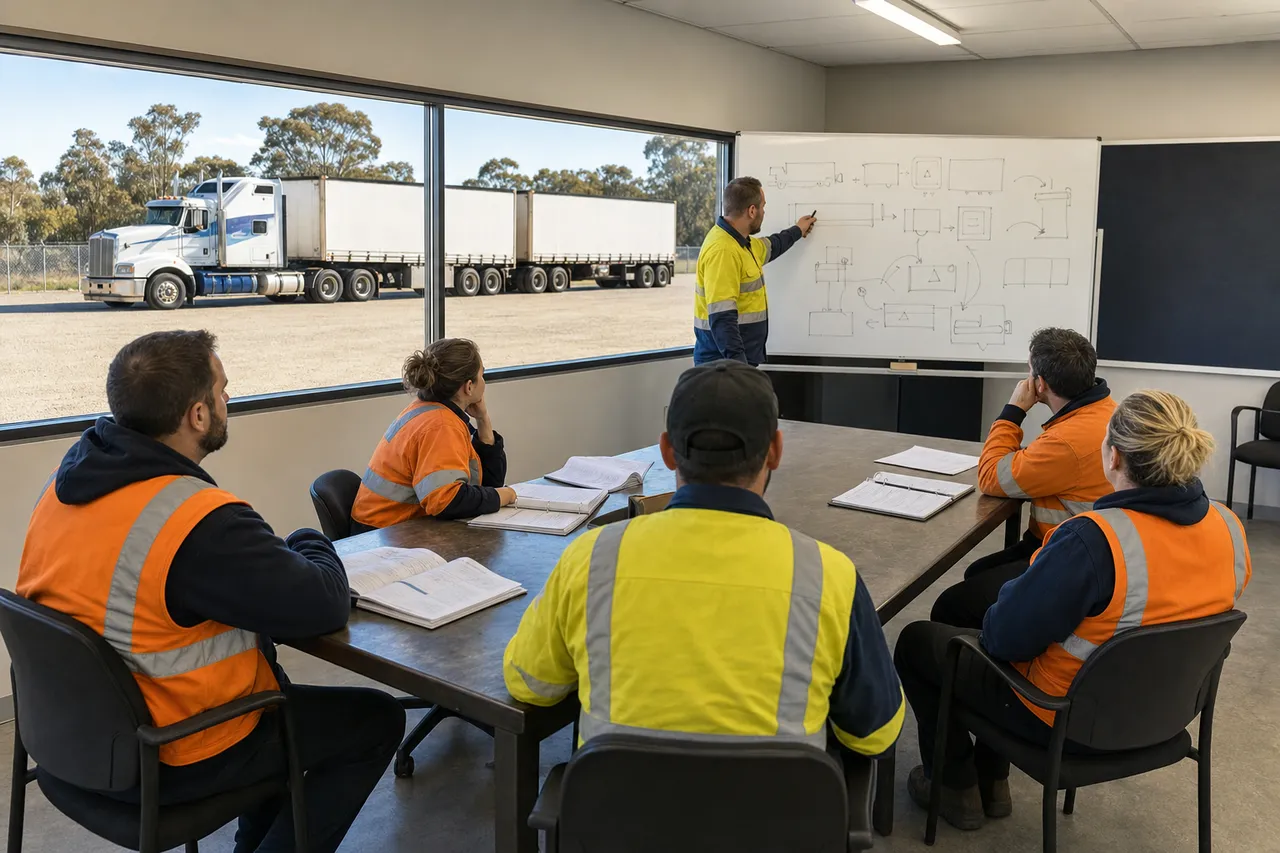
What is the Chain of Responsibility in Australian transport law?
The Chain of Responsibility (CoR) is the part of the Heavy Vehicle National Law (HVNL) that makes parties other than drivers responsible for the safety of heavy vehicle transport operations. Under HVNL Part 1A.1, Section 26A establishes the principle of shared responsibility — every party with influence over a transport task bears a duty to ensure safety. This means that consignors, packers, loaders, schedulers, operators, and consignees all carry legal obligations, not just the driver behind the wheel. The National Heavy Vehicle Regulator (NHVR) administers and monitors compliance with these duties across participating jurisdictions.
If you operate heavy vehicles or influence a transport task in Australia, you need to understand exactly where your duty sits, what it requires operationally, and how to produce evidence that you have met it. MAEZ helps operators stop losing sleep over fines, accreditation risk, and scattered evidence — and this guide lays out the framework you need to act on.
Key takeaways
- The HVNL creates a primary duty (Section 26C) on every party in the transport chain to ensure, so far as is reasonably practicable, the safety of heavy vehicle activities.
- Executives of legal entities carry a separate personal duty under Section 26D — this is not delegable by outsourcing.
- Offences for breaching CoR duties are tiered: Category 1 (most serious, Section 26F) through to lower categories, with penalties scaling to severity.
- Section 26E prohibits requests, contracts, and arrangements that would cause another party to breach the HVNL — this targets indirect pressure to speed, overload, or skip rest.
- Building defensible evidence through a Safety Management System and NHVAS accreditation is the most practical way to demonstrate compliance.
Who are the Chain of Responsibility duty holders under the HVNL?
The HVNL identifies multiple parties in the supply chain, each carrying duties proportional to their capacity to influence the transport task. The core Chain of Responsibility duty holders include:
- Consignors — parties who commission the carriage of goods by heavy vehicle.
- Packers — parties who pack or assemble goods for transport.
- Loaders — parties who load goods onto a vehicle, including managing weight distribution and restraint.
- Drivers — the person operating the heavy vehicle.
- Operators — the person or entity responsible for the vehicle's operation, including scheduling and maintenance.
- Schedulers — parties who set or influence the timing of journeys and rest periods.
- Consignees — parties who receive goods at the destination.
- Prime contractors — parties who engage others to perform transport work.
- Executives of legal entities — directors, partners, and senior officers who control or influence the entity's compliance.
The critical point is that you can hold more than one role simultaneously. A transport company that operates its own fleet, schedules its own drivers, and loads its own vehicles holds the duties of operator, scheduler, and loader at the same time.
What is the primary duty under HVNL Section 26C?
Section 26C of the HVNL establishes the primary duty for all parties in the chain. This duty requires each party to ensure, so far as is reasonably practicable, the safety of heavy vehicle transport activities. The duty covers all aspects of the transport task that the party can influence — including vehicle mass, load restraint, driver fatigue, speed management, and vehicle standards.
Operationally, this means a consignor cannot simply hand freight to a carrier and wash their hands of safety. If a consignor provides inaccurate weight information that leads to an overloaded vehicle, the consignor has breached their primary duty. Similarly, a scheduler who plans a route that makes it impossible for a driver to complete within legal work hours has breached their duty.
The phrase "so far as is reasonably practicable" is central. It means a duty holder must weigh the likelihood of a risk against what can reasonably be done to eliminate or minimise it. This is not a blank cheque — the NHVR and courts expect documented evidence of risk assessment and mitigation.
What is the executive duty under HVNL Section 26D?
Section 26D imposes a distinct duty on executives of legal entities that carry HVNL obligations. An executive — typically a director, partner, or senior manager — must exercise due diligence to ensure the entity complies with its primary duty under Section 26C.
This duty is personal and cannot be delegated. An executive cannot avoid liability by outsourcing compliance to a consultant or a software platform. The executive must actively:
- Acquire and keep up-to-date knowledge of the entity's CoR obligations.
- Understand the nature of the transport operations and the associated risks.
- Ensure the entity has, and uses, appropriate resources and processes to manage those risks.
- Ensure the entity has, and implements, processes for reporting, investigating, and resolving CoR breaches.
This is why Chain of Responsibility training for executives and managers is not a box-ticking exercise. Executives who cannot demonstrate due diligence face personal prosecution, separate from any action taken against the entity.
What are prohibited requests and contracts under HVNL Section 26E?
Section 26E of the HVNL addresses a common operational risk: indirect pressure to breach the law. The section prohibits a person from making a request, entering into a contract, or engaging in any arrangement that would cause, encourage, or induce another party to breach the HVNL.
In practice, this means:
- A consignor cannot set a delivery deadline that requires a driver to exceed legal work hours to meet it.
- A prime contractor cannot offer a rate per kilometre so low that the only way to make a profit is to speed or skip maintenance.
- A customer cannot contractually require a carrier to carry a mass that exceeds vehicle limits.
The section captures both explicit and implicit pressure. If the terms of a contract make compliance effectively impossible, the contract itself is a breach. This is why contract review and freight rate justification are essential components of a defensible CoR system.
How are CoR breaches categorised and penalised?
The HVNL tiers offences into categories based on the severity of the breach and the level of risk created. Under Part 1A.3:
- Category 1 offence (Section 26F) — applies where a person breaches a duty and is reckless about the risk to safety. This carries the highest penalties, including potential imprisonment for individuals and substantial fines for corporations.
- Category 2 offence (Section 26G) — applies where a person breaches a duty and is negligent about the risk to safety.
- Lower categories apply where the breach creates a risk but without the elevated mental elements of recklessness or negligence.
The tiered structure means that a duty holder who can demonstrate genuine, documented efforts to comply is in a fundamentally different position to one who ignored the risk entirely. This is where evidence quality matters — a Safety Management System that records risk assessments, corrective actions, and training creates a demonstrable compliance posture.
What are the fatigue management duties under HVNL Chapter 6?
Chapter 6 of the HVNL governs driver fatigue management. The duties in this chapter extend well beyond the driver. Section 264 imposes a duty on employers, prime contractors, operators, and schedulers to ensure driver compliance with work and rest hour requirements.
Key operational requirements include:
- Standard hours (Division 2 of Part 6.2) — solo and two-up drivers must operate within prescribed maximum work and minimum rest limits.
- BFM (Basic Fatigue Management) and AFM (Advanced Fatigue Management) — accreditation schemes that allow alternative work and rest schedules subject to stricter management conditions.
- Work diary requirements — Section 293 requires drivers of fatigue-regulated heavy vehicles to carry and maintain a work diary. Sections 294–300 prescribe the information that must be recorded, including odometer readings, work start and stop times, and rest periods.
- Enforcement powers — Sections 539–542 allow authorised officers to require a driver to rest, stop working if impaired by fatigue, or stop working if the work diary cannot be produced or is unreliable.
For operators, the practical implication is clear: you must have systems to verify driver work diaries, cross-check against scheduling records, and identify discrepancies before the NHVR finds them for you. MAEZ can help you build these checks into your daily operations.
What are the transport documentation duties under HVNL Chapter 5?
The HVNL places specific obligations on parties who prepare or provide transport documentation. Under Division 3 of Chapter 5:
- Section 186 — prohibits false or misleading transport documentation for goods. A person must not provide information that they know, or ought reasonably to know, is false or misleading.
- Section 187 — addresses false or misleading information in a container weight declaration. Given the safety implications of incorrect container weights, this duty sits squarely with consignors and packers.
- Sections 188–190 — establish the duty of the responsible entity for container weight declarations, including the requirement that a complying declaration be provided before the container is transported.
These provisions mean that paperwork accuracy is not an administrative nicety — it is a CoR duty. A consignor who under-declares the weight of a container is breaching the HVNL directly, regardless of whether the driver or operator subsequently overloads the vehicle.
How does NHVAS accreditation support CoR compliance?
The National Heavy Vehicle Accreditation Scheme (NHVAS) is the NHVR's formal accreditation framework. It provides structured pathways for operators to demonstrate that their management systems meet recognised standards. NHVAS modules include:
- Mass Management — systems to ensure vehicles operate within legal mass limits.
- Maintenance Management — structured vehicle maintenance and inspection programs.
- Basic Fatigue Management (BFM) — accredited fatigue management under alternative work and rest schedules.
- Advanced Fatigue Management (AFM) — higher-tier fatigue management with customised schedules.
NHVAS accreditation is not mandatory for all operators, but it provides two significant advantages. First, it creates a structured, audited evidence base that supports a due diligence defence. Second, it can provide regulatory benefits such as reduced inspection rates. For many operators, NHVAS accreditation is the foundation of a credible CoR posture.
What is a Safety Management System and why do CoR duty holders need one?
A Safety Management System (SMS) is a structured, documented framework for managing transport safety risks. Under the NHVR's Master Code and the broader HVNL duty framework, an SMS demonstrates that a duty holder has systematically identified risks, implemented controls, and maintained records.
A defensible SMS should include:
- Risk register covering mass, load restraint, fatigue, speed, vehicle standards, and documentation.
- Policies and procedures for each CoR role the business holds (operator, scheduler, consignor, etc.).
- Training records showing that relevant personnel understand their duties.
- Incident reporting and investigation processes.
- Contract review processes to identify prohibited requests under Section 26E.
- Internal audit and review cycles.
- Corrective action tracking with evidence of implementation.
CoRGuard, available at chainresponsibility.au, is the SaaS SMS platform that helps operators build and maintain this evidence base. It does not remove liability or guarantee compliance — but it creates the structured, retrievable evidence that a duty holder needs to demonstrate what was reasonably practicable.
How MAEZ helps operators build defensible CoR evidence
MAEZ provides advisory, training, and risk-closing services for Australian transport operators. The approach is practical and evidence-focused:
- Chain of Responsibility Training — delivered through cortraining.com.au, covering driver, manager, and executive obligations under the HVNL.
- Chain of Responsibility Consulting — gap reviews, system design, and NHVAS readiness support.
- Chartered risk gap reviews — using a chartered risk lens to identify and close CoR exposures before they become enforcement matters. See Using a Chartered Risk Lens to Close Chain of Responsibility Gaps.
- CoRGuard SMS platform — software implementation path for operators who need structured, software-based evidence management.
- Chain of Responsibility Course — formal training for staff at all levels of the supply chain.
The objective is straightforward: help you stop losing sleep over fines, accreditation risk, and scattered evidence by building a system that is auditable, defensible, and aligned to the HVNL.
What should Australian CoR duty holders do next?
If you hold a duty under the HVNL — as an operator, consignor, scheduler, loader, or executive — the following steps create a practical pathway:
- Identify your CoR roles — map every point where your business influences a transport task. You may hold multiple roles simultaneously.
- Assess your current evidence — do you have documented risk assessments, training records, and policies for each role? If not, that is your first gap.
- Train your people — ensure drivers, schedulers, managers, and executives understand their specific duties. Training is available at cortraining.com.au and through MAEZ's training programs.
- Review contracts and freight requests — check for provisions that could constitute a prohibited request under Section 26E.
- Implement or upgrade your SMS — whether through CoRGuard, a manual system, or a hybrid approach, ensure your evidence is structured and retrievable.
- Consider NHVAS accreditation — if you operate under BFM, AFM, Mass Management, or Maintenance Management, accreditation provides both regulatory benefits and evidence value.
- Get a gap review — contact MAEZ for a structured assessment of your CoR posture before the NHVR does one for you.
For more insights on transport compliance and CoR developments, browse MAEZ Insights.
Frequently asked questions
What is the Chain of Responsibility under the HVNL?
The Chain of Responsibility (CoR) is the part of the Heavy Vehicle National Law that places shared safety duties on every party who influences a heavy vehicle transport task — including consignors, packers, loaders, drivers, operators, schedulers, consignees, and executives of legal entities. The principle of shared responsibility is established in HVNL Section 26A.
Who is an HVNL duty holder?
An HVNL duty holder is any person or entity that has a role in the transport chain and the capacity to influence the safety of a heavy vehicle activity. This includes operators, schedulers, consignors, consignees, packers, loaders, prime contractors, drivers, and executives of companies that carry transport obligations.
What is the executive duty under the HVNL?
Under Section 26D of the HVNL, executives of legal entities must exercise due diligence to ensure the entity complies with its primary CoR duty. This duty is personal and cannot be delegated. Executives must acquire and maintain knowledge of CoR obligations, understand transport risks, and ensure the entity has adequate processes and resources to manage those risks.
What penalties apply for breaching Chain of Responsibility duties?
The HVNL tiers CoR offences by severity. Category 1 offences (Section 26F) apply where a duty holder is reckless about safety risk and carry the highest penalties, including potential imprisonment. Category 2 offences (Section 26G) apply where a duty holder is negligent. Lower categories apply to breaches that create risk without recklessness or negligence.
Is NHVAS accreditation required for CoR compliance?
NHVAS accreditation is not mandatory for all operators, but it provides a structured, audited framework that demonstrates compliance with specific HVNL obligations. NHVAS modules include Mass Management, Maintenance Management, Basic Fatigue Management, and Advanced Fatigue Management. Accreditation supports a due diligence defence and can provide regulatory benefits.
Does CoRGuard software guarantee compliance?
No. CoRGuard is a SaaS Safety Management System platform that helps operators build and maintain structured, retrievable evidence of their CoR compliance efforts. It does not remove liability, guarantee compliance, or replace the need for competent advice. It supports evidence management so duty holders can demonstrate what was reasonably practicable.
How often should CoR training be refreshed?
CoR training should be refreshed whenever there are changes to HVNL obligations, changes to a person's role in the transport chain, or when an incident or audit reveals a knowledge gap. At minimum, annual refresher training is recommended for all duty holders, with executive-level training aligned to due diligence requirements under Section 26D.
Frequently asked questions
Practical answers
- What is the Chain of Responsibility under the HVNL?
- The Chain of Responsibility (CoR) is the part of the Heavy Vehicle National Law that places shared safety duties on every party who influences a heavy vehicle transport task — including consignors, packers, loaders, drivers, operators, schedulers, consignees, and executives of legal entities. The principle of shared responsibility is established in HVNL Section 26A.
- Who is an HVNL duty holder?
- An HVNL duty holder is any person or entity that has a role in the transport chain and the capacity to influence the safety of a heavy vehicle activity. This includes operators, schedulers, consignors, consignees, packers, loaders, prime contractors, drivers, and executives of companies that carry transport obligations.
- What is the executive duty under the HVNL?
- Under Section 26D of the HVNL, executives of legal entities must exercise due diligence to ensure the entity complies with its primary CoR duty. This duty is personal and cannot be delegated. Executives must acquire and maintain knowledge of CoR obligations, understand transport risks, and ensure the entity has adequate processes and resources to manage those risks.
- What penalties apply for breaching Chain of Responsibility duties?
- The HVNL tiers CoR offences by severity. Category 1 offences (Section 26F) apply where a duty holder is reckless about safety risk and carry the highest penalties, including potential imprisonment. Category 2 offences (Section 26G) apply where a duty holder is negligent. Lower categories apply to breaches that create risk without recklessness or negligence.
- Is NHVAS accreditation required for CoR compliance?
- NHVAS accreditation is not mandatory for all operators, but it provides a structured, audited framework that demonstrates compliance with specific HVNL obligations. NHVAS modules include Mass Management, Maintenance Management, Basic Fatigue Management, and Advanced Fatigue Management. Accreditation supports a due diligence defence and can provide regulatory benefits.
- Does CoRGuard software guarantee compliance?
- No. CoRGuard is a SaaS Safety Management System platform that helps operators build and maintain structured, retrievable evidence of their CoR compliance efforts. It does not remove liability, guarantee compliance, or replace the need for competent advice. It supports evidence management so duty holders can demonstrate what was reasonably practicable.
- How often should CoR training be refreshed?
- CoR training should be refreshed whenever there are changes to HVNL obligations, changes to a person's role in the transport chain, or when an incident or audit reveals a knowledge gap. At minimum, annual refresher training is recommended for all duty holders, with executive-level training aligned to due diligence requirements under Section 26D.