MAEZ guide
Chain of Responsibility Training for Executives and Managers: NHVAS, SMS, and HVNL Duty Readiness
Chain of Responsibility training for Australian executives and managers builds the knowledge, evidence, and Safety Management System discipline needed to meet HVNL duties and protect NHVAS accreditation. MAEZ helps operators stop losing sleep over fines, accreditation risk, and scattered evidence.
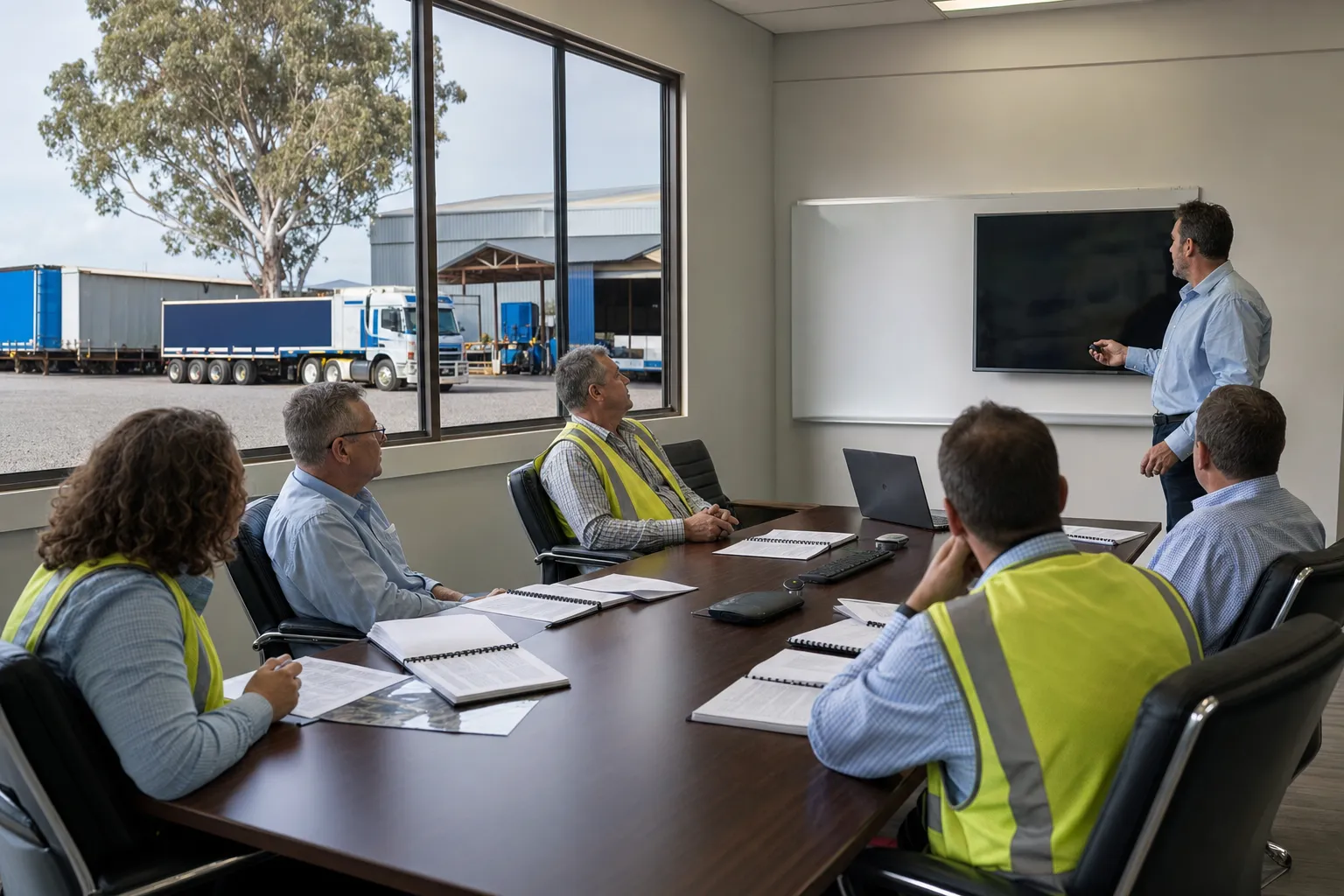
What is Chain of Responsibility training for executives and managers?
Chain of Responsibility (CoR) training for executives and managers is structured education that explains the duties each party in a heavy vehicle transport chain owes under the Heavy Vehicle National Law (HVNL), what those duties mean operationally day-to-day, and how a business must demonstrate it has taken reasonable steps to prevent breaches. It is not a generic awareness session. It is targeted at people who hold legal duties — operators, schedulers, consignors, consignees, loaders, packers, and particularly executives of legal entities — and it must connect the law to the systems, records, and behaviours a business actually relies on.
The HVNL creates a shared responsibility framework across every party that influences a transport activity. Training is the mechanism that turns that legal framework into understood, visible, and auditable practice. Without it, executives and managers are exposed to personal liability, the business is exposed to Category 1 and Category 2 offences, and NHVAS accreditation becomes fragile because the Master Code expects documented, trained, and supervised systems.
Key takeaways
- The HVNL imposes a primary duty on each party in the chain (s 26C) and a separate executive duty on directors and senior officers of a legal entity (s 26D). Training is how executives discharge that personal duty.
- Category 1 and Category 2 offences (ss 26F, 26G) apply where a duty holder fails to eliminate or minimise a safety risk so far as is reasonably practicable. Ignorance of the obligation is not a defence.
- NHVAS accreditation requires a documented Safety Management System, trained personnel, and records that demonstrate the Master Code is being followed. CoR training is evidence that supports accreditation.
- A Safety Management System (SMS) is the operational backbone that captures policies, procedures, risk registers, maintenance schedules, fatigue management records, and driver diary checks. Training ensures people know how to use it.
- MAEZ helps operators stop losing sleep over fines, accreditation risk, and scattered evidence. Training is delivered through cortraining.com.au, and CoRGuard — the SaaS SMS platform at chainresponsibility.au — is the implementation path where software evidence is needed.
Who needs Chain of Responsibility training under the HVNL?
Every party that exercises control or influence over a transport activity is a CoR duty holder. That means training is not just for drivers or transport managers. The HVNL names specific roles, and each carries obligations:
- Consignors — must not consign goods unless the vehicle, mass, loading, and fatigue arrangements are compliant.
- Consigees — must take reasonable steps to ensure they do not receive goods carried in breach.
- Packers — must ensure packing does not cause the vehicle to exceed mass or dimension limits or create a load restraint risk.
- Loaders — must ensure the load is placed, secured, and distributed lawfully.
- Drivers — must comply with work and rest hours, maintain a work diary where required, and not drive while impaired by fatigue.
- Operators — must ensure vehicles are maintained, drivers are fit, schedules are achievable, and records are kept.
- Schedulers and dispatchers — must not set routes or times that pressure drivers into fatigue breaches.
- Executives — directors and senior officers of a corporate entity have a personal duty under s 26D to ensure the entity complies with its primary duty.
If your business touches any of these roles, training is relevant. The broader and more complex your supply chain, the more critical it becomes. A detailed breakdown of each duty holder and their obligations is essential reading for managers building a training matrix.
What does the HVNL primary duty actually require?
Under Part 1A.2 of the HVNL, section 26C establishes a primary duty on each party in the chain. The duty requires each party to ensure, so far as is reasonably practicable, the safety of transport activities relating to a heavy vehicle. This is not a narrow obligation about one vehicle or one trip. It captures the whole of the transport activity that the party influences.
The principle of shared responsibility (s 26A) means no single party can discharge the entire chain's obligation alone. A consignor cannot say "the operator will handle it" and walk away. An operator cannot say "the driver should have checked the load." Each party must identify the risks they influence and take reasonable steps.
Section 26B sets out the principles applying to duties: a duty may not be transferred, each party must comply with their duty, and each party must take all reasonable steps to ensure compliance. Training is the mechanism that makes those steps visible, repeatable, and defensible.
What is the executive duty under HVNL s 26D?
Section 26D of the HVNL imposes a duty of executive of a legal entity. If a corporation is a party in the chain, an executive of that corporation must ensure, so far as is reasonably practicable, that the corporation complises with its primary duty.
This is a personal duty. It sits on the individual executive, not just on the company. An executive who does not actively ensure compliance — who does not know what the CoR obligations are, does not resource a Safety Management System, does not verify training and records — is personally exposed.
The practical implication is direct: executives need CoR training not as a box-ticking exercise but because the law expects them to understand the risks, direct controls, and confirm evidence. An executive who cannot explain what the business does to manage fatigue, mass, load restraint, and speed is an executive who has not discharged s 26D.
What are Category 1 and Category 2 offences?
Part 1A.3 of the HVNL sets out the offence categories for failing to comply with a duty:
- Category 1 offence (s 26F) — the most serious, involving a breach that exposes an individual to a risk of death or serious injury or illness, or a risk of serious property damage, and the duty holder was reckless or negligent about that risk.
- Category 2 offence (s 26G) — a breach where the duty holder failed to comply with the duty and the failure caused a substantial risk of death or serious injury, but without the reckless or negligent element of Category 1.
These are not abstract. A scheduler who sets an impossible delivery window that forces a driver to exceed work hours, a consignor who knowingly overloads a vehicle, or an operator who ignores maintenance defects can all attract these offences. Executives who fail to oversee these systems can be personally charged.
Training builds the awareness and internal controls that prevent these exposures. It also builds the documentary evidence — training records, policy acknowledgements, risk assessments — that demonstrates reasonable steps were taken.
How does CoR training support NHVAS accreditation?
NHVAS accreditation is the National Heavy Vehicle Regulator's scheme that allows accredited operators to operate under agreed work and rest arrangements, mass, maintenance, and fatigue management systems. To hold accreditation, a business must comply with the NHVAS Master Code, which requires documented systems, trained personnel, internal review, and records.
CoR training directly supports NHVAS accreditation because:
- It ensures managers understand the obligations that the SMS is designed to meet.
- It produces evidence that personnel have been instructed in the policies and procedures the Master Code requires.
- It strengthens the link between the written system and day-to-day practice, which is what an NHVR audit examines.
- It prepares executives to answer the questions an auditor will ask about how the business manages fatigue, mass, maintenance, and speed.
If your NHVAS accreditation is due for audit, or you have had a near-miss, training is one of the fastest ways to close the gap between what the system says and what the evidence shows.
How does a Safety Management System connect to CoR training?
A Safety Management System (SMS) is the structured framework a transport business uses to manage safety risks across its operations. It includes policies, procedures, risk registers, responsibilities, maintenance schedules, fatigue management plans, incident reporting, driver diary checks, and records of review.
Under the HVNL, the SMS is the operational expression of the primary duty. The law does not prescribe a single SMS format, but it expects that a business can demonstrate it has identified risks, implemented controls, trained people, and reviewed performance.
CoR training and an SMS are inseparable. Training teaches people what the SMS requires and why. The SMS provides the structure within which trained behaviours are recorded and verified. If training happens but there is no SMS to capture it, the knowledge dissipates. If an SMS exists but no one is trained in it, the documents are inert.
CoRGuard, the SaaS SMS platform at chainresponsibility.au, is the implementation path where software evidence is needed. MAEZ is the advisory, training, and gap-closing offering that helps operators build the system correctly before — or alongside — software.
What should CoR training for executives and managers actually cover?
Effective training for executives and managers should cover:
- The HVNL legal framework — the primary duty (s 26C), executive duty (s 26D), prohibited requests and contracts (s 26E), and offence categories (ss 26F, 26G).
- Duty holder roles — consignor, consignee, packer, loader, driver, operator, scheduler, and executive — and what each must do.
- Fatigue management — work and rest hours, work diary requirements under Chapter 6, driver base recording, and what triggers a breach.
- Mass, dimension, and loading — how overloading occurs, who is responsible, and what records demonstrate compliance.
- Speed and scheduling — why unrealistic delivery windows create CoR liability and how to document reasonable scheduling.
- Load restraint — the standards, who checks them, and how to evidence that loading was supervised.
- Transport documentation — s 186 prohibits false or misleading transport documentation for goods. Executives must understand who generates these documents and how they are verified.
- Incident response and reporting — what to do when a breach is detected, how to preserve evidence, and how to use the incident to improve the SMS.
- NHVAS Master Code alignment — how training records feed into accreditation evidence.
- Reasonable steps defence — what a court or regulator will look for when assessing whether a duty holder took all reasonable steps.
Training should be practical, scenario-based, and specific to Australian transport operations. Generic safety training that does not reference the HVNL, the NHVR, and the Master Code will not prepare executives for the questions that matter.
What are the reasonable steps a business must demonstrate?
The concept of "reasonable steps" is central to CoR compliance. The HVNL expects each duty holder to take all reasonable steps to ensure compliance. What is reasonable depends on the size of the business, the nature of the transport activity, the degree of control the party has, and the foreseeability of the risk.
Reasonable steps typically include:
- Identifying the transport activities the business influences and the risks within them.
- Implementing policies and procedures that address those risks.
- Training personnel on those policies and their legal obligations.
- Maintaining records that show the policies were followed.
- Reviewing incidents and near-misses and updating controls.
- Auditing suppliers, contractors, and sub-hauliers for compliance.
- Ensuring contracts do not contain clauses that encourage or require breaches (s 26E prohibits prohibited requests and contracts).
Training is both a reasonable step in itself and the mechanism that makes other reasonable steps effective. A business that trains its schedulers not to set impossible routes, and can produce the training records and the scheduling policy, is in a far stronger position than one that simply says "we told them to be careful."
How does fatigue management fit into executive CoR training?
Chapter 6 of the HVNL governs driver fatigue. It sets out work and rest hour requirements, work diary obligations, and the categories of breaches. Executives and managers need to understand this chapter because fatigue management is one of the most common sources of CoR enforcement.
Key operational points:
- Drivers of fatigue-regulated heavy vehicles must carry and maintain a work diary under Part 6.4.
- Schedulers must not create rosters that make compliance with rest requirements impossible.
- Operators must verify driver work diaries and manage fatigue-related records.
- An executive who does not know whether the business checks work diaries, does not know how schedules are built, and does not know what happens when a fatigue breach is detected, has not discharged s 26D.
MAEZ currently supports fatigue and driver diary checks as part of its compliance advisory. An Electronic Work Diary is not yet live; current capability focuses on manual and digital diary verification, scheduling review, and fatigue record management.
What is changing under the HVNL 2026 reforms and why does training matter now?
The HVNL is undergoing reform, with amendments expected to take effect from 1 August 2026. The reforms build on the existing primary duty and executive duty framework, strengthen the role of the Safety Management System, and place greater emphasis on proactive risk management and evidence.
For executives and managers, the 2026 changes mean:
- The expectation that a business has a functioning SMS will be more explicit.
- The role of training in demonstrating reasonable steps will be more prominent.
- The executive duty under s 26D will remain a personal obligation, and enforcement attention on individuals is expected to increase.
- NHVAS accreditation will continue to be a key compliance pathway, and businesses that have not trained their people or documented their systems will struggle to demonstrate readiness.
Read the practical guide to HVNL 2026 changes and CoR training readiness for a detailed breakdown of what the reforms mean for your operation.
How to build a CoR training plan for your executive team
A structured training plan for executives and managers should include:
- Baseline assessment — identify which duties each executive and manager holds, what their current knowledge is, and where the gaps are. A chartered risk review can surface these gaps with professional rigour.
- Targeted training delivery — use CoR training that is specifically designed for Australian transport operators and references the HVNL, NHVR, and Master Code. Training delivered through cortraining.com.au is designed for this context.
- System integration — ensure training is connected to the SMS. Each policy, procedure, and risk control should be explained during training so people know what they are responsible for and where the evidence lives.
- Record creation — capture attendance, assessment results, policy acknowledgements, and dates. These records are your evidence of reasonable steps.
- Periodic refresh — CoR is not a one-time event. Refresher training should be scheduled annually, when legislation changes (such as the August 2026 HVNL reforms), and when new personnel take on duty-holder roles.
- Executive sign-off — the executive team should review training coverage at least annually and confirm it is satisfied the business is meeting its duties.
How MAEZ helps operators stop losing sleep over compliance
MAEZ is the expert advisory, training, and chartered risk offering for Australian transport operators. We help you understand your CoR obligations, close the gaps that create liability, and build the evidence that protects your business and your executives.
Our approach is practical:
- We assess your current systems against the HVNL, the NHVAS Master Code, and the expectations of the NHVR.
- We deliver Chain of Responsibility training that is grounded in the legislation and tailored to the roles in your business.
- We help you build or strengthen your Safety Management System so that training, records, and daily practice are connected.
- We provide CoR consulting and risk review services that identify where your exposure is highest and what to do about it.
- Where you need software to manage evidence, CoRGuard at chainresponsibility.au is the SaaS SMS platform that operationalises the system we help you build.
We do not provide legal advice, we do not guarantee compliance, and we do not claim software removes liability. What we do is help you build a defensible, auditable, and practical compliance posture so that when the NHVR asks questions, you have answers.
What to do next
If you are an executive or manager in an Australian transport business, the steps are straightforward:
- Understand your duty — review the About Chain of Responsibility page and the duty holders guide to confirm which roles apply to you.
- Book training — access practical Chain of Responsibility training through cortraining.com.au for your executive team, managers, schedulers, and dispatch staff.
- Review your SMS — if you do not have a documented Safety Management System, or if it has not been reviewed in the last 12 months, arrange a CoR consulting engagement.
- Check your NHVAS readiness — if you hold or are seeking accreditation, confirm your training records and evidence are audit-ready. See how MAEZ helps protect NHVAS accreditation.
- Contact MAEZ — contact us for a tailored advisory conversation about your operation, your risks, and your training needs.
Training is the foundation. Evidence is the protection. MAEZ helps you build both so you can stop losing sleep over fines, accreditation risk, and scattered records.
Frequently asked questions
Practical answers
- Who needs Chain of Responsibility training under the HVNL?
- Every party that influences a heavy vehicle transport activity needs CoR training. This includes consignors, consignees, packers, loaders, drivers, operators, schedulers, and executives of corporate entities. Under HVNL s 26D, executives have a personal duty to ensure their company complies with its primary duty, so executive and manager training is not optional — it is how that personal duty is discharged.
- What is the executive duty under the HVNL?
- Section 26D of the HVNL imposes a duty on executives of a legal entity to ensure, so far as is reasonably practicable, that the entity complies with its primary duty under s 26C. This is a personal duty on the individual executive, not just on the company. An executive who does not understand the CoR obligations, does not resource a Safety Management System, and does not verify training and records is personally exposed to Category 1 or Category 2 offences.
- How does CoR training support NHVAS accreditation?
- NHVAS accreditation requires a documented Safety Management System, trained personnel, and records that demonstrate compliance with the Master Code. CoR training produces evidence that personnel understand their obligations and the procedures they must follow. It strengthens the link between the written system and daily practice, which is exactly what an NHVR audit examines. Without training records, accreditation evidence is incomplete.
- What is a Safety Management System and why does it matter for CoR?
- A Safety Management System (SMS) is the structured framework a transport business uses to manage safety risks — including policies, procedures, risk registers, maintenance schedules, fatigue management plans, and driver diary checks. Under the HVNL, the SMS is the operational expression of the primary duty. CoR training teaches people how to use the SMS, and the SMS provides the structure within which trained behaviours are recorded and verified.
- What are Category 1 and Category 2 offences under the HVNL?
- Category 1 offences (s 26F) are the most serious, applying where a duty breach exposes an individual to a risk of death, serious injury, or serious property damage and the duty holder was reckless or negligent. Category 2 offences (s 26G) apply where a duty holder failed to comply with their duty and the failure caused a substantial risk of death or serious injury. Both can apply to individuals, including executives, and to corporate entities.
- When do the HVNL 2026 reforms take effect and what do they mean for training?
- HVNL amendments are expected to take effect from 1 August 2026. The reforms strengthen the existing primary duty and executive duty framework, place greater emphasis on Safety Management Systems and proactive risk management, and increase the expectation that businesses can demonstrate training and evidence. Operators should begin training and system strengthening now, before the changes take effect, so they are ready on day one.
- Does MAEZ provide legal advice or guarantee compliance?
- No. MAEZ provides expert advisory, training, and chartered risk review services to help operators understand and meet their HVNL obligations. We do not provide legal advice, we do not guarantee compliance, and we do not claim that software — including the CoRGuard SaaS SMS platform — removes liability. Our role is to help you build a defensible, auditable compliance posture so that when the NHVR asks questions, you have answers.