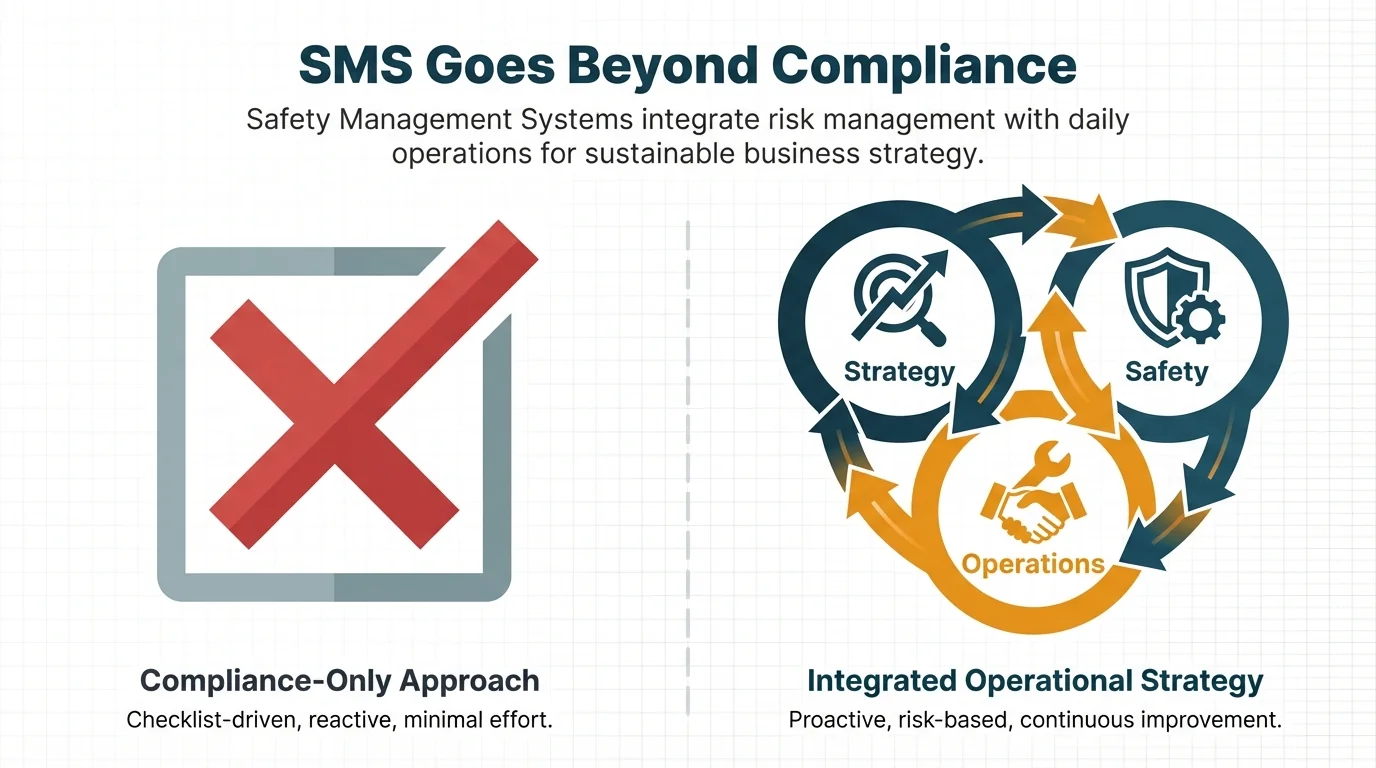
Most organisations approach safety management system implementation as a compliance project. This creates a fundamental problem.
Your SMS needs to function as part of your operational strategy, not a checkbox exercise. Integrating SMS into core business strategy by focusing on hazard identification, risk assessment, proactive controls, and performance improvement delivers outcomes that compliance alone never achieves.
The reality is that effective safety management systems reduce incidents, control operational costs, and create workplace environments where employees actively participate in risk management. When you implement an SMS properly, you establish systematic processes for identifying hazards, assessing risks, implementing controls, and continuously improving safety performance.
This guide provides the practical framework for SMS implementation based on recognised standards and proven approaches. You’ll understand the core components, the sequential steps for implementation, and the management systems that support ongoing safety performance.
Understanding Safety Management Systems
A safety management system represents a structured framework for managing workplace safety through documented policies, procedures, and practices.
The SMS approach differs from traditional safety programs in three significant ways. First, it emphasises proactive hazard identification rather than reactive incident response. Second, it integrates safety into daily operations instead of treating it as a separate function. Third, it establishes systematic processes for continuous improvement.
Your SMS implementation creates a foundation for managing workplace risks systematically. The framework includes policy development, hazard identification processes, risk assessment procedures, control implementation, performance monitoring, and continuous improvement cycles.
Standards like ISO 45001 and regulatory frameworks provide implementation guidance. These standards establish common elements: management leadership, worker participation, hazard identification, risk assessment, operational controls, training programs, performance monitoring, and improvement processes.
The system works through integrated components. Management establishes policies and allocates resources. Workers participate in hazard identification and reporting. Systematic processes assess risks and implement controls. Training develops competencies. Monitoring tracks performance. Reviews identify improvement opportunities.
Benefits of Implementing a Safety Management System
SMS implementation delivers measurable operational benefits beyond regulatory compliance.
Organisations that implement safety management systems systematically reduce workplace incidents. The proactive approach identifies hazards before they cause injuries or illnesses. Risk assessments enable targeted control measures. This prevention focus reduces workers’ compensation costs, insurance premiums, and incident-related operational disruptions.
Productivity improves through several mechanisms. Workers in safe environments experience fewer interruptions from incidents and investigations. Equipment maintenance improves when mechanical integrity for critical equipment like pressure vessels and piping is ensured through documented inspections, tests, and tracking tools. Systematic processes reduce variability in safety performance.
Employee engagement strengthens when organisations demonstrate commitment to safety. Workers who see management investing in hazard controls and responding to safety concerns develop greater organisational trust. This engagement extends beyond safety to overall job satisfaction and retention.
Your SMS creates documentation that demonstrates due diligence. This documentation becomes critical during regulatory inspections, incident investigations, and legal proceedings. Systematic records of hazard assessments, training, inspections, and corrective actions provide evidence of reasonable care.
The continuous improvement cycle drives ongoing performance gains. Regular performance reviews identify trends. Root cause analyses address systemic issues. Management reviews allocate resources to priority areas. This iterative approach creates sustained safety improvements.
Core Components of an Effective Safety Management System
Every effective SMS incorporates specific foundational elements that work together as an integrated system.
Management Leadership and Commitment
Leadership commitment establishes the foundation for SMS success. Senior management demonstrates this commitment through resource allocation, policy approval, and active participation in safety activities.
Visible leadership actions matter more than policy statements. Executives who attend safety meetings, participate in incident investigations, and discuss safety performance in business reviews signal organisational priorities. This visibility influences employee behaviour more effectively than written policies.
Resource allocation proves commitment. Adequate budgets for safety equipment, training programs, and personnel enable implementation. Management decisions about competing priorities reveal actual commitment levels.
Worker Participation and Engagement
Involving employees by creating participation plans, consulting on program elements, and providing access to relevant safety information strengthens SMS effectiveness significantly.
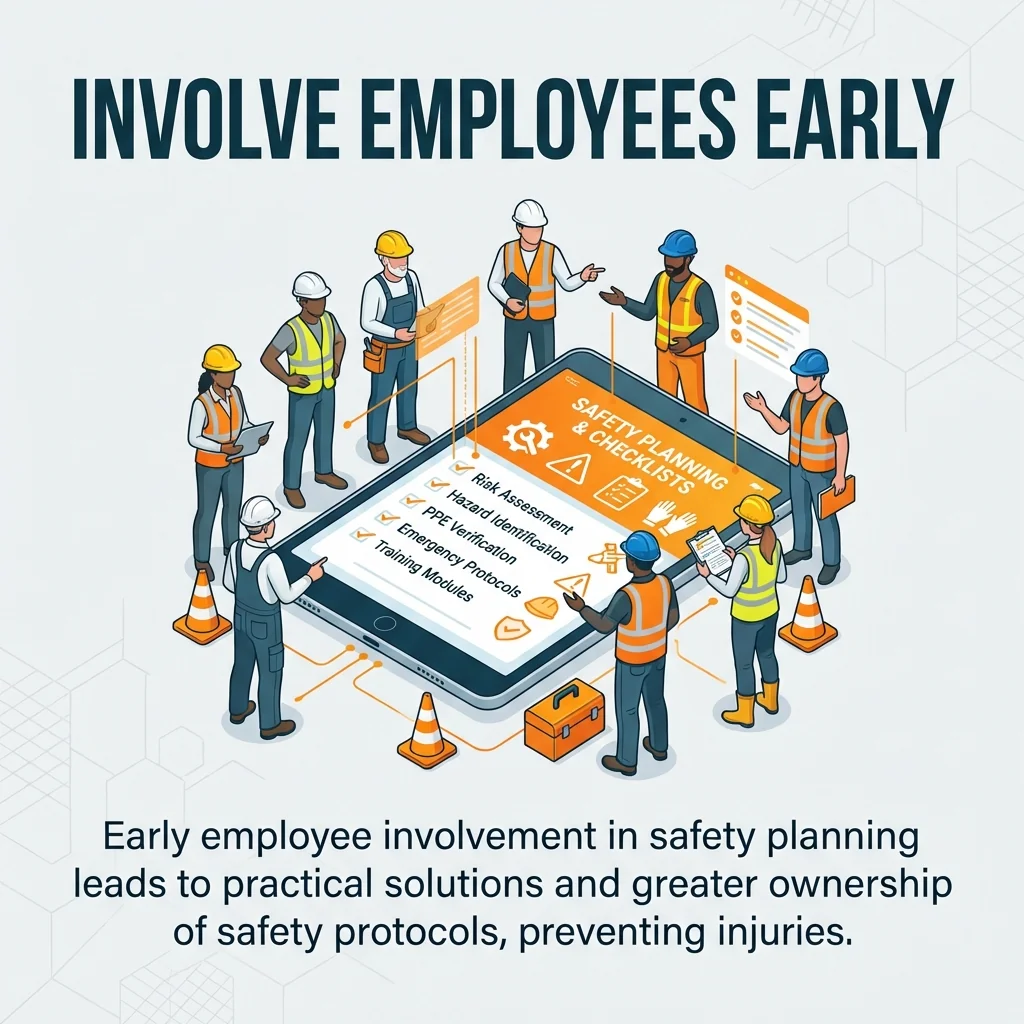
Workers possess practical knowledge about workplace hazards that management often lacks. Frontline employees understand equipment limitations, process variations, and operational challenges. This knowledge becomes critical for identifying realistic hazards and developing workable controls.
Participation mechanisms include safety committees, hazard reporting systems, incident investigation involvement, and consultation on procedure development. Multiple participation channels ensure diverse employee perspectives inform safety decisions.
Hazard Identification and Risk Assessment
Systematic hazard identification forms the core of proactive safety management. Your organisation needs structured processes for identifying potential hazards before they cause incidents.
Effective identification methods include workplace inspections, job safety analyses, process hazard analyses, and incident trend reviews. Different methods identify different hazard types. Combining multiple approaches creates comprehensive coverage.
Risk assessment follows hazard identification. The assessment evaluates likelihood and potential severity. This evaluation enables priority ranking. High-risk hazards receive immediate attention and resources.
Documentation captures hazard identification and risk assessment results. This documentation informs control selection, tracks hazard status, and provides audit evidence. Regular reviews update assessments as conditions change.
Hazard Prevention and Control Measures
Control implementation addresses identified hazards through the hierarchy of controls approach.
Elimination removes hazards completely. Substitution replaces hazardous materials or processes with safer alternatives. Engineering controls isolate workers from hazards through physical barriers or ventilation. Administrative controls establish safe work procedures. Personal protective equipment provides the final protection layer.
Effective control implementation considers feasibility, cost, and worker acceptance. Controls that disrupt operations significantly face implementation resistance. Involving workers in control selection improves acceptance and compliance.
Your control program requires maintenance and verification. Equipment inspections confirm engineering controls function properly. Procedure audits verify administrative controls are followed. This ongoing verification prevents control degradation.
Safety Training and Education
Training develops worker competencies for recognising hazards and implementing controls. Your training program addresses new employee orientation, job-specific hazards, equipment operation, emergency procedures, and management responsibilities.
Effective training combines knowledge transfer with skill development. Workers need to understand hazards and know how to respond. Hands-on practice develops confidence and competence.
Training documentation records who received training, when it occurred, and what topics were covered. This documentation demonstrates compliance and identifies training gaps. Regular refresher training maintains competencies.
Performance Monitoring and Measurement
Systematic monitoring tracks SMS effectiveness through leading and lagging indicators.
Leading indicators measure proactive activities: inspections completed, hazards identified, training delivered, and corrective actions closed. These indicators predict future performance and enable early intervention.
Lagging indicators measure outcomes: injury rates, incident frequency, severity rates, and workers’ compensation costs. These indicators reveal performance trends and validate improvement efforts.
Regular performance reviews analyse indicator trends. Reviews identify improvement opportunities and areas requiring additional resources. This analysis informs management decisions about safety investments.
Preparing for Safety Management System Implementation
Successful SMS implementation requires careful preparation before launching formal processes.
Start with a gap analysis comparing current safety practices against your target standard or regulatory requirements. The analysis identifies existing strengths, practice gaps, and resource needs. This assessment informs your implementation plan.
Secure management commitment early. Present the business case including cost reduction potential, regulatory compliance benefits, and operational improvements. Authorizing the system through senior leader approval after risk analysis ensures alignment with organizational risk tolerance.

Establish a cross-functional implementation team. Include representatives from operations, maintenance, human resources, and frontline workers. Diverse perspectives strengthen program design and build organisational buy-in.
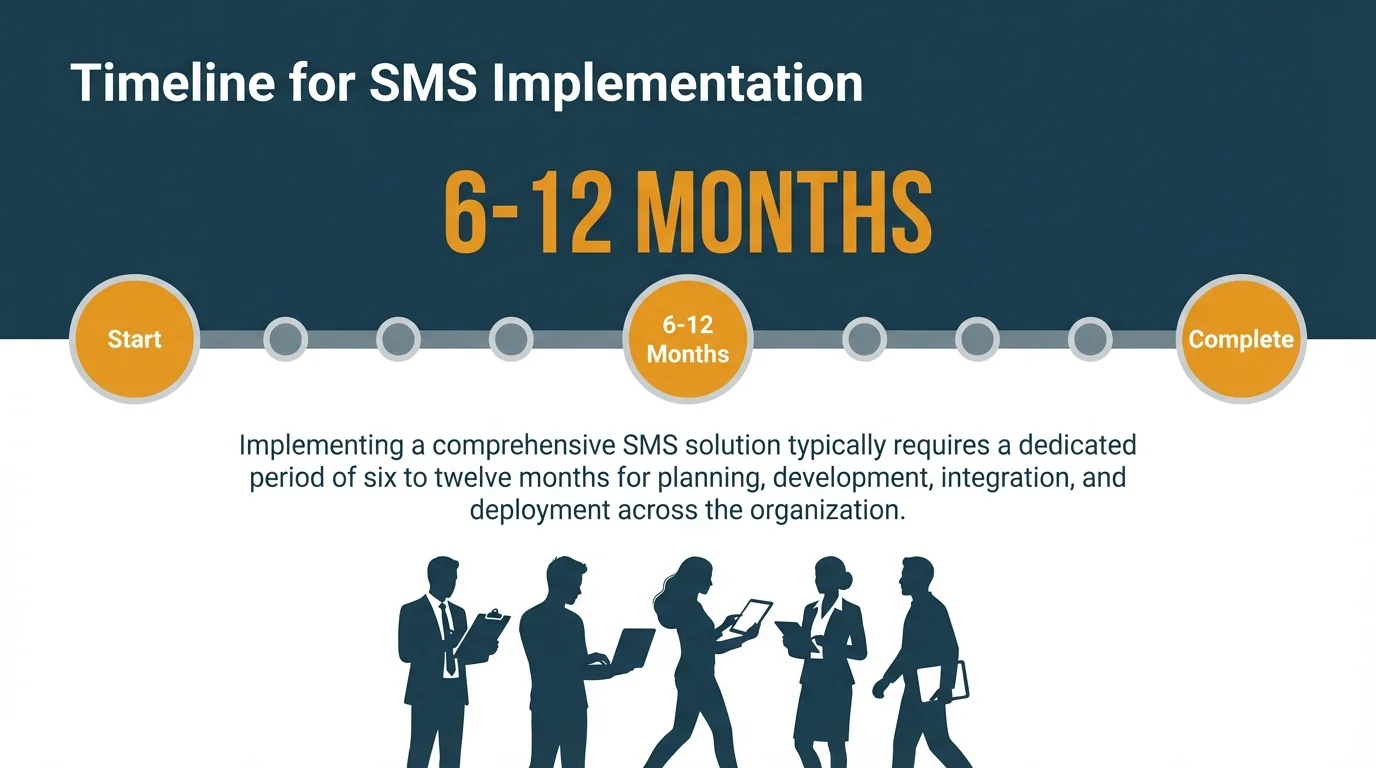
The implementation of a cross-functional team with a project plan can take a 6-12 month timeline based on organizational size. Realistic timelines prevent rushed implementation and allow adequate stakeholder consultation.
Your project plan should outline key milestones, resource requirements, and responsibility assignments. Clear timelines and accountability improve implementation consistency.
Establishing Safety Policies and Objectives
Your safety policy establishes the organisational commitment foundation and guides SMS implementation.
Effective safety policies contain several key elements. First, a clear commitment to preventing work-related injuries and illnesses. Second, commitment to legal compliance and applicable standards. Third, commitment to worker consultation and participation. Fourth, commitment to continuous improvement.
The policy should be brief, specific, and written in clear language. Avoid generic statements that could apply to any organisation. Include specific commitments relevant to your operations and hazards.
Senior management must approve and sign the policy. This approval demonstrates leadership commitment and authorises resource allocation for implementation.
Communicate the policy throughout the organisation. Post it visibly in work areas. Include it in employee handbooks. Reference it in training programs. Regular communication reinforces policy importance.
Safety objectives translate policy commitments into measurable targets. Effective objectives are specific, measurable, achievable, relevant, and time-bound. Examples include reducing injury rates by specific percentages, completing hazard assessments for all operations, achieving training completion targets, or implementing specific control measures.
Your objectives should align with identified risks and organisational priorities. Regular progress reviews track objective achievement and enable course corrections.
Developing Hazard Identification Processes
Systematic hazard identification requires structured processes that capture diverse hazard types.
Workplace Inspection Programs
Regular inspections identify physical hazards, unsafe conditions, and control deficiencies. Your inspection program defines inspection frequency, scope, and responsibility.
Different areas require different inspection frequencies. High-risk areas need more frequent inspections than low-risk locations. New operations require initial intensive inspections before establishing routine frequencies.
Inspection checklists ensure consistency and comprehensiveness. Checklists should cover equipment conditions, housekeeping, emergency equipment, personal protective equipment availability, and control effectiveness.
Documentation captures inspection findings, assigns corrective actions, and tracks completion. This documentation provides performance trends and audit evidence.
Job Hazard Analysis
Job hazard analysis systematically evaluates tasks to identify potential hazards. The process breaks jobs into steps, identifies hazards at each step, and determines appropriate controls.
Prioritise high-risk jobs for analysis first. Jobs with injury history, high severity potential, or frequent performance require early analysis. Gradually expand to cover all significant operations.
Involve workers who perform the jobs. Their practical knowledge identifies hazards that desk-based analysis misses. Worker involvement also improves control acceptance.
Incident and Near-Miss Reporting
Effective reporting systems capture incidents and near-misses that reveal hazards. Your reporting system should be accessible, simple, and non-punitive.
Near-miss reporting provides early warning of potential serious incidents. Encouraging near-miss reports requires building trust that reporters won’t face discipline for identifying hazards.
Timely investigation and response demonstrate that reports lead to action. Visible corrective actions encourage continued reporting. Feedback to reporters closes the communication loop.
Implementing Risk Assessment and Control Selection
Risk assessment evaluates identified hazards to prioritise control efforts and resource allocation.
Your risk assessment process should evaluate two factors: likelihood of occurrence and potential severity. Various matrix approaches combine these factors into risk rankings.
Likelihood considers frequency of exposure, probability of the hazard occurring, and existing control effectiveness. Historical incident data informs likelihood estimates.
Severity considers potential injury types, number of people exposed, and worst-case consequences. Severity evaluation should consider realistic scenarios, not just theoretical possibilities.
Risk rankings guide control selection and implementation priority. High-risk hazards require immediate interim controls and permanent solution development. Medium-risk hazards need planned controls. Low-risk hazards require monitoring but may not need additional controls.
Control selection follows the hierarchy of controls. Evaluate elimination and substitution first. Consider engineering controls next. Use administrative controls to supplement higher-level controls. Rely on personal protective equipment only when other controls are infeasible.
Document your control decisions including the rationale for selected controls. This documentation demonstrates your systematic approach and supports future reviews.
Creating Safety Training and Competency Programs
Your training program develops worker competencies for safe work performance and hazard recognition.
New Employee Orientation
New worker training covers general safety policies, emergency procedures, hazard reporting systems, and employee rights and responsibilities. This foundation training occurs before job-specific training.
Orientation should familiarise new employees with your safety culture and expectations. Clear communication about safety priorities from the first day influences long-term behaviour.
Job-Specific Training
Job training addresses specific hazards workers encounter and controls they must implement. Training content comes directly from job hazard analyses and risk assessments.
Effective job training includes hands-on practice with equipment, procedures, and controls. Demonstration and practice develop competence better than classroom instruction alone.
Training should occur before workers perform hazardous tasks independently. Adequate supervision during the initial performance period ensures competency development.
Supervisor and Manager Training
Supervisors and managers need additional training on their SMS responsibilities. This includes conducting inspections, investigating incidents, enforcing procedures, and recognising training needs.
Leadership training develops skills for promoting safety culture. Supervisors learn to reinforce safe behaviours, address unsafe acts, and model safety commitment.
Refresher Training
Regular refresher training maintains competencies and addresses identified performance gaps. Annual refresher programs work for most topics. High-risk activities may require more frequent training.
Refresher training updates workers on procedure changes, new hazards, and lessons learned from incidents. This ongoing education maintains awareness and competency.
Establishing Performance Monitoring Systems
Systematic monitoring tracks SMS implementation and identifies improvement opportunities.
Your monitoring program should include multiple methods: workplace inspections, procedure audits, training records review, incident investigations, and performance indicator tracking.
Inspection programs verify that controls remain effective and procedures are followed. Regular inspections identify emerging hazards and control deficiencies before incidents occur.
Procedure audits verify that documented procedures reflect actual practices. Gaps between written procedures and actual work indicate needed updates or additional training.
Incident investigations identify root causes and systemic issues. Effective investigations look beyond immediate causes to underlying management system failures.
Performance indicators quantify safety performance trends. Your indicator program should balance leading and lagging indicators. Leading indicators measure proactive activities. Lagging indicators measure outcomes.
Regular management reviews analyse monitoring results. These reviews identify trends, evaluate control effectiveness, and determine needed resources. Management commitment to acting on review findings maintains program credibility.
Driving Continuous Improvement
Continuous improvement processes ensure your SMS evolves with changing operations and emerging risks.
Your improvement cycle includes performance monitoring, root cause analysis, corrective action implementation, and effectiveness verification. This cycle operates continuously, not just after incidents.
Corrective action programs track identified deficiencies through resolution. Effective programs assign clear responsibility, establish completion timelines, and verify effectiveness after implementation.
Preventive action addresses potential problems before they occur. Trend analysis, near-miss reviews, and external incident learning inform preventive actions.
Management reviews occur at planned intervals to evaluate SMS effectiveness. Reviews should cover performance indicators, audit findings, incident trends, legal compliance, and improvement opportunities.
Your reviews should result in decisions about resource allocation, objective updates, and program modifications. Documented review decisions demonstrate management commitment and guide implementation priorities.
Worker participation in improvement activities strengthens program effectiveness. Safety committees review performance data, recommend improvements, and monitor corrective action completion.
Key Questions About Safety Management System Implementation
How do you implement a safety management system?
Implement a safety management system by gaining leadership commitment, conducting a gap analysis of current practices against standards like ISO 45001, developing policies and procedures, training employees, performing internal audits, and continuously monitoring performance through management reviews.
What are the 4 pillars of safety management system?
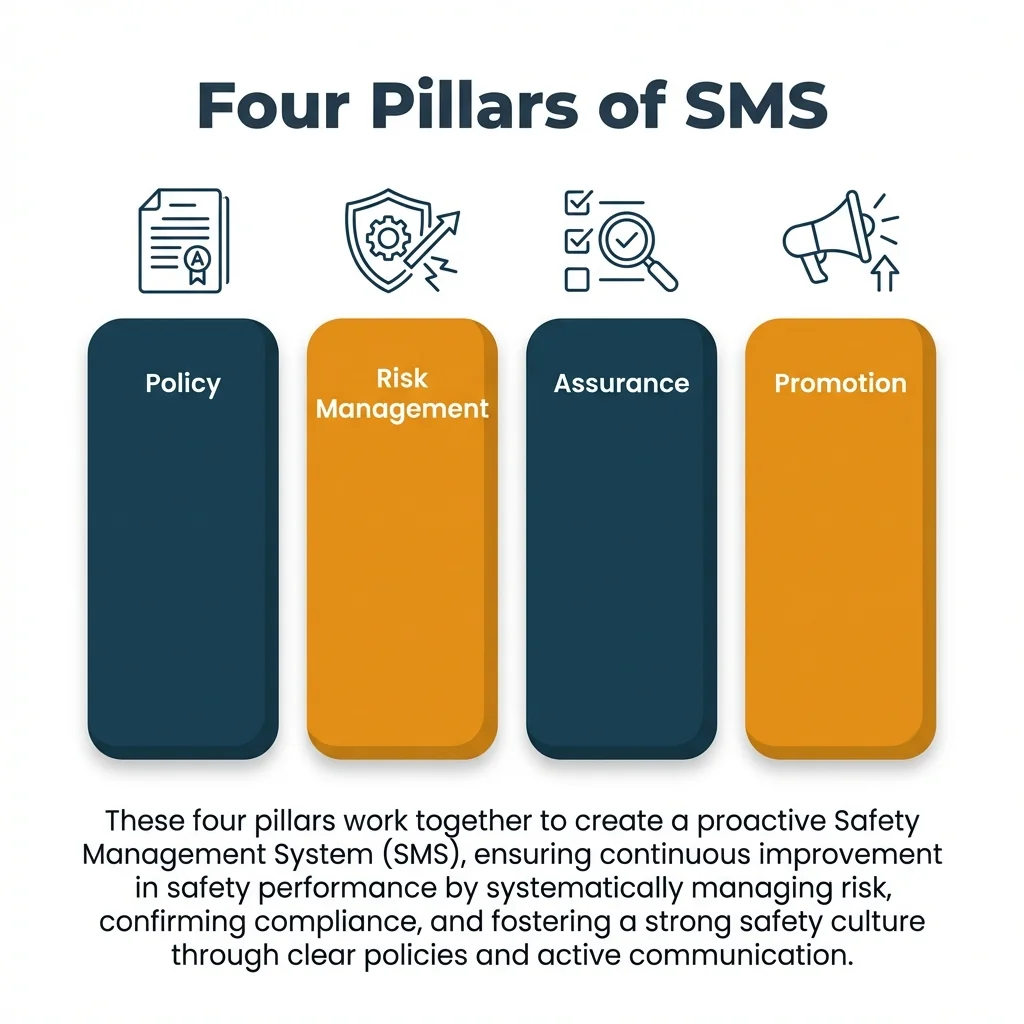
The four pillars of a Safety Management System are Safety Policy driving accountability, Safety Risk Management assessing and mitigating risks, Safety Assurance monitoring and identifying issues, and Safety Promotion training and communication using data.
What are five key elements of a safety management system?
Five key elements include leadership commitment and worker participation, hazard identification and risk assessment, operational controls and procedures, employee training and competence, and performance evaluation with continual improvement.
Moving Forward With Your Safety Management System
SMS implementation creates systematic safety management that reduces incidents, controls costs, and engages workers.
Start with your gap analysis. Understand where your current practices align with standards and where gaps exist. This assessment guides your implementation priorities and resource planning.
Secure management commitment early and maintain it through visible leadership actions. Resource allocation and active participation signal actual commitment more effectively than policy statements.
Build worker participation into every program element. Frontline knowledge identifies realistic hazards and practical controls. Participation creates ownership and strengthens program effectiveness.
Implement systematically but remain flexible. Standard frameworks provide structure, but your SMS must fit your operations. Adapt standard elements to your specific hazards, risks, and organisational culture.
Focus on continuous improvement rather than perfect initial implementation. Your SMS will evolve as you learn what works in your environment. Regular reviews and adjustments create sustained performance gains.
For transport and logistics organisations managing Chain of Responsibility compliance, integrating SMS with regulatory obligations creates efficiency. Explore additional compliance management resources that complement your safety management system implementation.