Chain of Responsibility compliance isn’t about ticking boxes on a spreadsheet. It’s about creating a living, breathing safety culture that protects your business, your drivers, and everyone sharing the road with your vehicles.
After 25 years in supply chain and logistics, I’ve watched too many transport operators rely on outdated manual processes. They scramble when the National Heavy Vehicle Regulator comes knocking. Their compliance systems exist in scattered spreadsheets, forgotten file cabinets, and someone’s memory.
That approach doesn’t work anymore.
The Heavy Vehicle National Law makes every party in the supply chain accountable for safety breaches. Your consignor, your scheduler, your loading manager, even your executive team carry legal obligations. One weak link puts everyone at risk.
This guide shows you how to build a CoR compliance system that actually functions in the real world. You’ll understand what the law requires, who’s responsible, and how to create processes that protect your business whilst making operations smoother.
No generic advice. No theoretical frameworks that collapse under pressure. Just practical steps based on regulatory requirements and real transport operations.
What Chain of Responsibility Actually Means Under Australian Law
Chain of Responsibility (CoR) is a legal framework under Australia’s Heavy Vehicle National Law (HVNL) that extends accountability for safety breaches across all parties in the transport and supply chain. That accountability doesn’t stop at the driver or the transport operator.
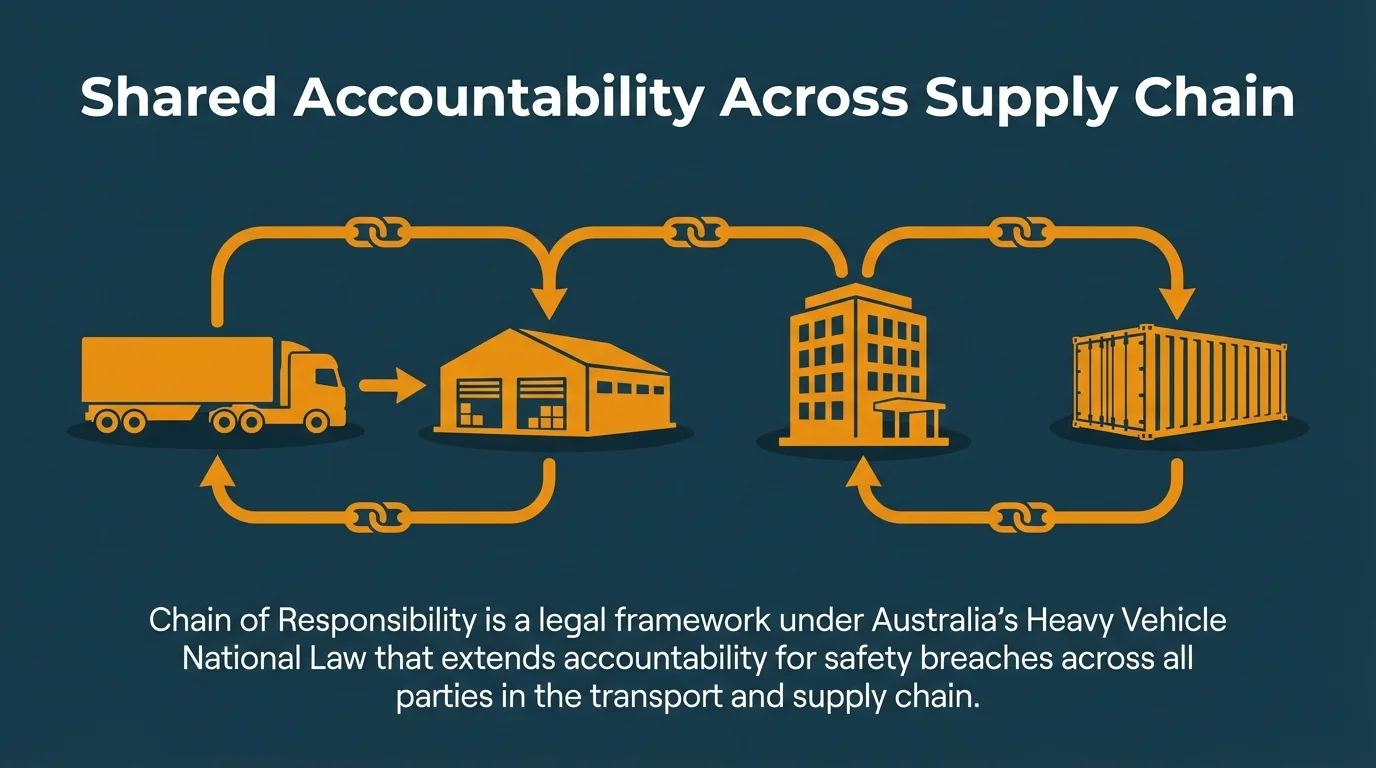
The law recognises that safety failures rarely happen in isolation. A driver exceeding speed limits might be responding to unrealistic delivery schedules. An overloaded vehicle often results from decisions made at the loading dock or in a customer’s warehouse.
CoR addresses this reality by identifying every party who influences transport safety. Each party carries a primary duty to eliminate or minimise safety risks, so far as is reasonably practicable.
Think of it as shared accountability. Everyone who can influence safety outcomes must take reasonably practicable steps to prevent breaches.
The Five Core Safety Areas CoR Covers
The HVNL focuses CoR obligations on specific, measurable safety risks:
- Driver fatigue management and work hour compliance
- Mass, dimension and loading requirements
- Speed compliance and vehicle condition
- Load restraint and securing standards
- Vehicle standards and maintenance obligations
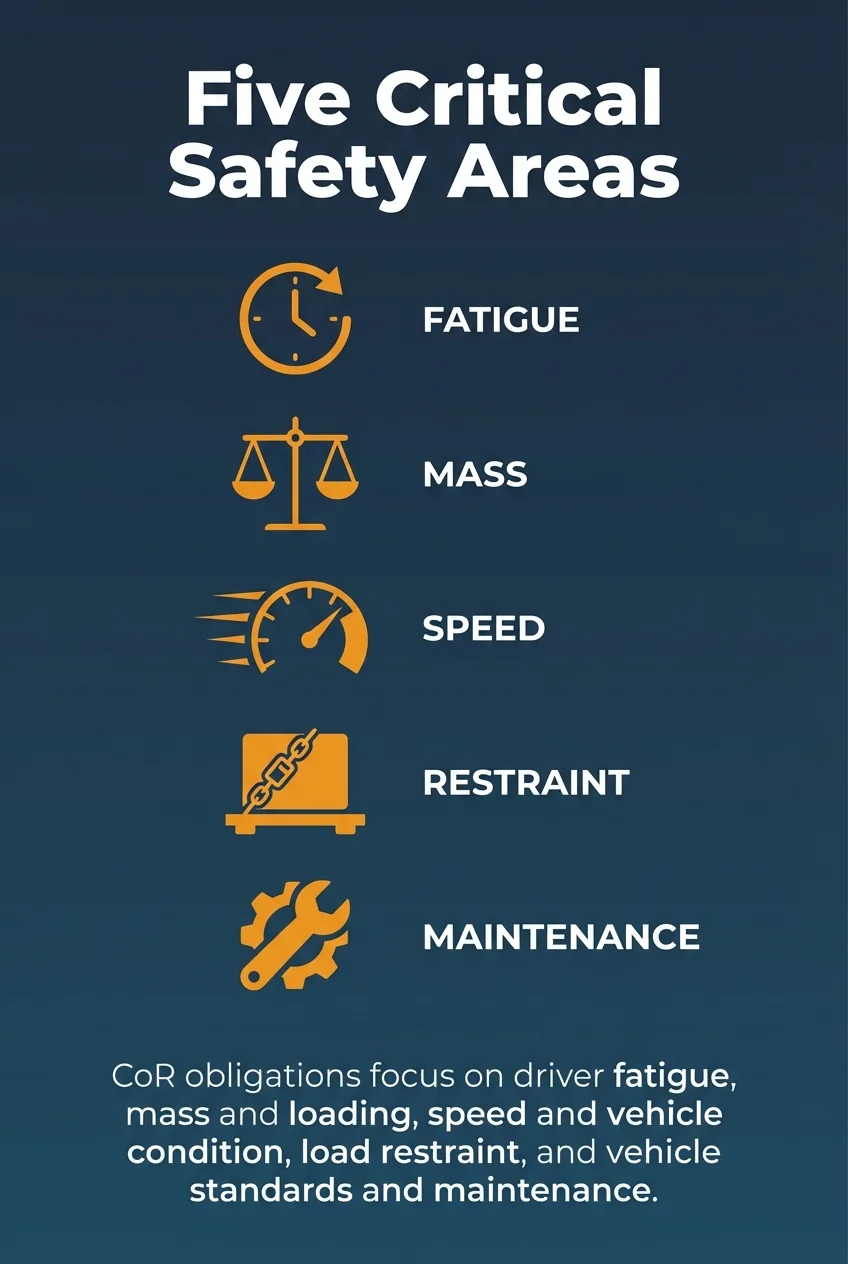
Each area represents a common source of heavy vehicle incidents. The law requires you to manage these risks systematically, not reactively.
How CoR Differs From Traditional Operator-Only Responsibility
Traditional transport regulation placed most obligations on the operator and driver. CoR fundamentally changed this model.
Now, anyone who exercises control or influence in the supply chain shares responsibility. That includes businesses that might never own or operate a truck.
A manufacturer setting delivery windows carries obligations. A warehouse manager directing loading procedures carries obligations. An executive approving transport contracts carries obligations.
This isn’t about shifting blame. It’s about recognising that effective safety requires action from everyone who can prevent problems.
Who Carries Legal Obligations in Your Supply Chain
Understanding exactly who’s in the Chain of Responsibility determines how you structure your compliance system. The HVNL identifies specific parties based on their role and influence.
The Primary Parties and Their Typical Roles
The law defines several party types. Each has distinct responsibilities based on how they interact with heavy vehicle operations.
| Party Type | Typical Role | Primary Influence Area |
|---|---|---|
| Employer | Employs drivers or operates vehicles | Driver selection, training, rostering, vehicle maintenance |
| Prime Contractor | Engages operators for transport services | Service requirements, delivery timeframes, contractor selection |
| Operator | Operates transport business under own authority | Fleet management, driver supervision, operational procedures |
| Scheduler | Controls or directs driver work and rest times | Route planning, delivery scheduling, work hour allocation |
| Consignor | Consigns goods for transport | Packaging, labelling, mass declarations, delivery requirements |
| Consignee | Receives goods at destination | Unloading facilities, receiving windows, access requirements |
| Packer | Manages how goods are packed | Container packing, weight distribution, securing methods |
| Loading Manager | Controls or supervises loading activities | Load placement, weight compliance, restraint application |
| Loader | Loads goods onto vehicles | Physical loading, weight distribution, initial restraint |
| Unloader | Unloads goods from vehicles | Unloading procedures, restraint removal, safety during unloading |
One business often fulfils multiple party roles. A transport operator might be the employer, operator, scheduler, and loading manager simultaneously.
Executive Officers Have Separate Due Diligence Duties
Beyond the primary parties, the HVNL places specific obligations on executive officers. This includes directors, secretaries, and anyone making significant operational decisions.
Executives must exercise due diligence to ensure their organisation complies with CoR obligations. This isn’t passive oversight. It requires active engagement with safety systems.
Due diligence means understanding the transport operations, ensuring appropriate resources exist, monitoring compliance performance, and acting when problems surface.
You can’t delegate this duty to a transport manager and walk away. The law expects executives to maintain knowledge and active involvement.
What the Primary Duty Actually Requires You to Do
Every party in the Chain of Responsibility carries a primary duty. This duty forms the foundation of the entire compliance framework.
The primary duty requires you to ensure the safety of your transport activities, so far as is reasonably practicable. That phrase “reasonably practicable” matters enormously.
Understanding Reasonably Practicable Steps
Reasonably practicable doesn’t mean taking every conceivable action regardless of cost or feasibility. It means considering what you know, what you can do, and what’s appropriate given the circumstances.
The law expects you to weigh several factors:
- The likelihood of a safety breach occurring
- The potential harm if a breach occurs
- What you know or should know about the risks
- Available methods to eliminate or minimise risks
- The cost and practicality of implementing controls
A reasonably practicable step for a national logistics company differs from what’s reasonably practicable for a small business with three trucks. Resources, knowledge, and scale influence what the law expects.
But limited resources don’t excuse inaction. You must still take steps appropriate to your situation and influence.
From Duty to Daily Operations
Translating the primary duty into daily operations requires systematic thinking. You need processes that identify risks, implement controls, monitor performance, and improve continuously.
Start by mapping where your business influences transport safety. If you set delivery schedules, you influence driver fatigue. If you declare cargo weights, you influence mass compliance. If you specify routes, you influence speed and road safety.
For each influence point, ask three questions. What could go wrong? What can we do to prevent it? How do we know our controls work?
Your answers become your compliance system. Document them. Implement them. Review them regularly.
Building Your Safety Management System Foundation
A Safety Management System converts your legal obligations into operational reality. It’s the documented framework that shows how you manage CoR risks systematically.
Without a structured system, compliance depends on individual knowledge and memory. People forget. People leave. Procedures drift. Problems multiply.
The Core Components Every System Needs
An effective Safety Management System contains several interconnected elements. Each element serves a specific purpose in managing compliance.
First, you need clear policies that state your commitment to transport safety and legal compliance. These policies guide decision-making when situations arise.
Second, you need procedures that explain exactly how to perform safety-critical tasks. How do you verify mass declarations? How do you schedule drivers within legal work hours? How do you select and monitor contractors?
Third, you need records that prove you followed your procedures. Documentation demonstrates your due diligence when regulators ask questions.
Fourth, you need competent people who understand their roles and responsibilities. Training ensures everyone knows what’s expected and how to deliver it.
Fifth, you need monitoring and review processes that identify when things go wrong and drive improvement.
Documenting Processes That People Actually Follow
The best documented procedure is worthless if nobody follows it in practice. Your Safety Management System must reflect real operations, not aspirational ideals.
Start with how work actually happens. Observe current processes. Talk to the people doing the work. Identify gaps between what should happen and what does happen.
Design procedures that fit your operational reality. A scheduler working with tight delivery windows needs different tools than one with flexible timeframes. A loading manager at a fixed depot needs different controls than one managing multiple remote sites.
Write procedures in plain language. Avoid legal jargon. Use flowcharts and checklists. Make procedures accessible when people need them.
Test your procedures with the people who’ll use them. Adjust based on their feedback. If a procedure proves impractical, it won’t be followed consistently.
Managing Driver Fatigue Through Systematic Controls
Driver fatigue represents one of the highest risk areas under CoR. Tired drivers cause crashes. The law holds multiple parties accountable for fatigue management, not just the driver.
If you schedule drivers, set delivery times, or control work allocation, you influence fatigue outcomes. Your compliance system must address this influence systematically.
Understanding Your Fatigue Management Obligations
The HVNL sets strict work and rest hour requirements. Drivers must comply with these requirements. But compliance starts long before a driver gets behind the wheel.
Schedulers must create rosters and delivery schedules that allow legal compliance. This means understanding driving hour limits, rest break requirements, and how different fatigue management options work.
You can’t simply demand impossible delivery windows and expect drivers to sort it out legally. The law sees through that approach.
Consignors and consignees who set receiving times or loading windows also influence fatigue. Unrealistic timeframes or excessive waiting times push drivers toward breaches.
Practical Fatigue Controls You Can Implement Today
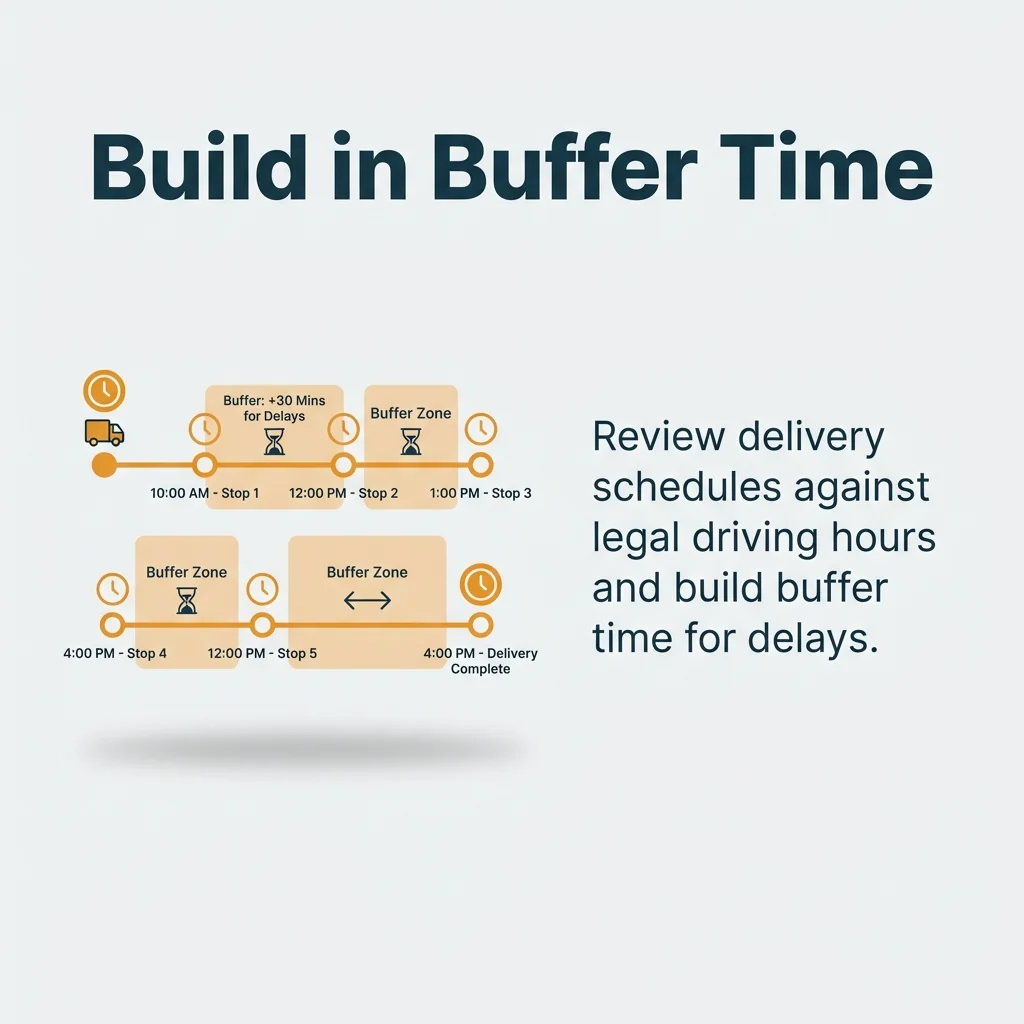
Start by reviewing your delivery schedules against legal driving hours. Can a driver reasonably complete the assigned work within their available hours? Build buffer time for delays.
Implement a process for drivers to raise fatigue concerns without fear of commercial pressure. Make it clear that raising a concern won’t result in lost work or punishment.
Monitor work hour compliance through regular reviews. If you use Electronic Work Diaries, review the data monthly. Look for patterns suggesting systemic pressure.
Train everyone who influences scheduling. They need to understand the work hour rules and how their decisions affect compliance.
Document your fatigue management approach. Show how you design schedules, how you respond to delays, how you monitor compliance, and how you address breaches.
Ensuring Mass Limits and Load Restraint Compliance
Overloaded vehicles and poorly restrained loads create obvious dangers. They also create clear legal liability under CoR for anyone who influences these factors.
Multiple parties typically influence mass and loading outcomes. The consignor declares weights. The packer arranges goods. The loader physically loads. The loading manager supervises. The operator manages overall compliance.
Where Mass Compliance Usually Breaks Down
Most mass breaches don’t result from deliberate overloading. They happen because of flawed processes and poor information flow.
Consignors provide inaccurate weight declarations. Standard cargo weights used in systems don’t match actual weights. No one verifies declared weights against reality. Loads get added without updating total mass calculations.
Your compliance system must create reliable weight information and verification processes.
Implement weighing procedures for goods being consigned. Use calibrated scales. Document the results. Provide accurate declarations to transport operators.
If you operate vehicles, verify consignor declarations before loading. Use onboard weighing systems or public weighbridges. Don’t accept obviously incorrect declarations.
Create mass management plans that show axle weight distribution, not just total vehicle mass. Understanding axle weights prevents legal mass breaches even when total weight seems acceptable.
Load Restraint Standards and Responsibilities
The Load Restraint Guide sets the Australian standard for safely securing loads. Anyone involved in packing, loading, or managing loading must understand and apply these standards.
Load restraint isn’t just about using enough straps. It’s about understanding forces, choosing appropriate restraint methods, and applying them correctly.
If you manage loading, develop and document standard loading procedures. Show which restraint methods apply to different load types. Specify inspection requirements.
Train loaders in proper restraint techniques. Demonstrate correct tensioning, anchor point selection, and verification methods.
Photograph loaded vehicles before departure. This creates evidence of proper restraint and supports your defence if questions arise later.

Contractor Management Under Chain of Responsibility
Using contractors doesn’t transfer your CoR obligations away. The law explicitly prevents this outcome.
When you engage transport contractors, you remain a party in the Chain of Responsibility. You must take reasonably practicable steps to ensure contractors comply with safety requirements.
Your Due Diligence Obligations for Contractor Selection
Selecting contractors based solely on price creates foreseeable safety risks. The law expects you to consider safety capability alongside commercial factors.
Before engaging a contractor, verify their compliance systems exist and function. Request evidence of their Safety Management System. Check their safety performance history. Verify their vehicles meet roadworthiness standards.
Ask about their fatigue management approach. How do they schedule drivers? What systems prevent work hour breaches? How do they monitor compliance?
Verify insurance coverage. Adequate insurance indicates a legitimate operation focused on proper compliance.
Document your selection process. Show what you checked, what you found, and why you concluded the contractor met acceptable standards.
Ongoing Contractor Monitoring and Performance Reviews
Contractor management doesn’t end at engagement. You must monitor ongoing performance and respond to compliance issues.
Establish regular review cycles. Quarterly reviews work well for most arrangements. Review safety incidents, compliance breaches, and any regulator interactions.
Create clear performance expectations in your contracts. Specify response times, reporting requirements, and consequences for safety breaches.
When contractors report problems or near misses, treat this positively. It shows they’re monitoring their operations and being transparent with you.
If serious breaches occur, investigate root causes. Was it a one-off mistake or a systemic failure? Your response should match the underlying problem.
Maintain contractor performance records. This documentation demonstrates your ongoing due diligence and supports decisions to continue or cease using particular contractors.
What Happens When Things Go Wrong: Penalties and Prosecution
Non-compliance with CoR can lead to penalties under HVNL, with the NHVR emphasising proactive systems to reduce incidents across the industry. Understanding the consequences focuses attention on prevention.
The HVNL creates several categories of offences with escalating penalties. Minor breaches attract infringement notices. Serious breaches can result in prosecution and substantial fines.
The Penalty Structure Under Heavy Vehicle National Law
CoR offences fall into three tiers based on severity and culpability.
Strict liability offences apply when you breach your primary duty. These don’t require proof of intent. If you failed to take reasonably practicable steps and a breach occurred, you’re liable. Maximum penalties reach tens of thousands of dollars for individuals and much higher for corporations.
Recklessness offences apply when you consciously disregard substantial safety risks. These carry significantly higher penalties, potentially exceeding hundreds of thousands of dollars.
The most serious category covers conduct that risks death or serious injury. Penalties here can reach millions of dollars for corporations.
Courts can also impose additional penalties beyond fines, including adverse publicity orders that damage business reputation.
How Regulators Decide Whether to Prosecute
The National Heavy Vehicle Regulator doesn’t prosecute every detected breach. They consider several factors when deciding whether to take enforcement action.
First, they examine the seriousness of the breach. Did it create immediate danger? Was it a repeat violation? Did it result in injury or damage?
Second, they consider your compliance history. Businesses with strong compliance systems and transparent reporting typically receive more lenient treatment than serial offenders.
Third, they evaluate your response when the breach was discovered. Did you cooperate with investigations? Did you implement corrective actions? Did you show genuine commitment to improvement?
Having documented Safety Management Systems helps your case enormously. It demonstrates you were taking reasonably practicable steps, even if a breach occurred despite your efforts.
The absence of any compliance system suggests you weren’t meeting your primary duty. This makes prosecution much more likely and undermines any defence.
Technology Solutions That Support CoR Compliance
Manual spreadsheet tracking fails for CoR compliance because it lacks automation for monitoring changes, ongoing assessments, and regulatory updates. Modern transport operations need purpose-built systems.
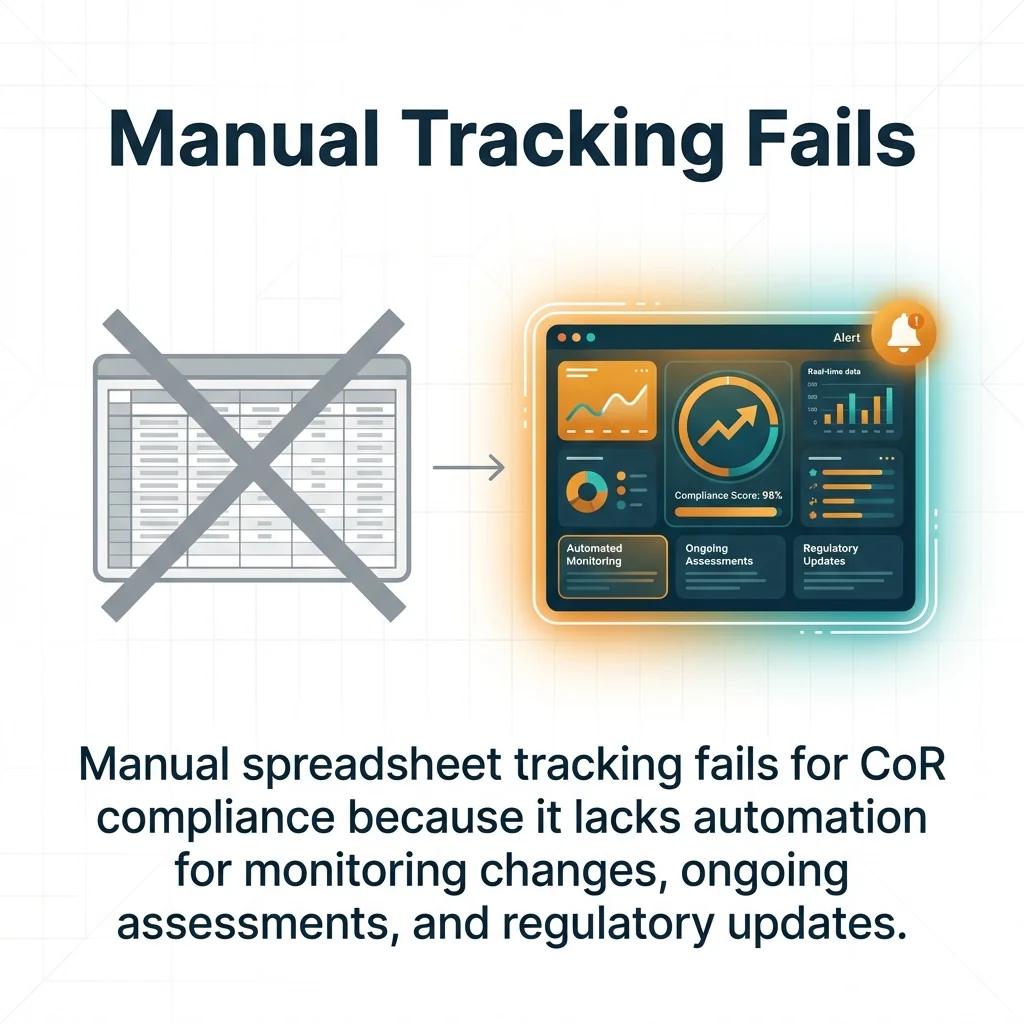
Technology can’t replace your compliance obligations, but it can make meeting them vastly more efficient and reliable.
What Compliance Software Should Actually Do
Effective compliance software centralises your Safety Management System. Instead of scattered documents and spreadsheets, everything exists in one accessible platform.
The system should manage your policies and procedures, making them available to everyone who needs them. Version control ensures people always access current documents.
Real-time monitoring capabilities track compliance across your operations. Electronic Work Diaries feed into fatigue management dashboards. Weighbridge data links to mass compliance records. Vehicle maintenance systems flag upcoming service requirements.
Automated alerts notify relevant people when action is required. A driver approaching work hour limits triggers scheduler notification. A missed vehicle service generates maintenance alerts. An expired contractor insurance policy prompts review.
Audit trails record who did what and when. This documentation proves your due diligence when regulators ask questions.
Integration Points That Multiply Value
Standalone compliance systems have limitations. The real power comes from integrating compliance software with your operational systems.
Connect your transport management system to compliance monitoring. Route planning automatically considers legal driving hours. Delivery scheduling flags potential fatigue risks before they occur.
Link weighbridge systems to compliance records. Every load verification automatically updates your mass management documentation.
Integrate contractor management with your procurement systems. Contract renewals trigger compliance reviews. Purchasing systems prevent engagement of contractors with lapsed credentials.
GPS and telematics data feeds into compliance monitoring. Speed violations generate immediate alerts. Route deviations prompt investigation. Vehicle location data verifies driver work declarations.
These integrations reduce manual data entry, improve accuracy, and create compliance processes that happen automatically as part of normal operations.
Creating a Compliance System That Improves Over Time
Your initial compliance system won’t be perfect. The goal is creating something that works today and gets better tomorrow.
Continuous improvement separates compliance systems that protect businesses from those that exist only on paper.
Building Meaningful Review Cycles Into Operations
Schedule regular compliance reviews at multiple levels. Daily checks catch immediate issues. Monthly reviews identify trends. Quarterly assessments examine systemic performance. Annual audits evaluate the entire framework.
Daily operational checks focus on specific compliance points. Did all drivers complete work diaries? Are vehicle inspections current? Do loading records show proper verification?
Monthly reviews look at compliance patterns. Are certain routes consistently creating fatigue pressure? Do particular consignors regularly provide inaccurate weights? Are specific contractors showing performance declines?
Quarterly assessments examine broader questions. Are your procedures still practical? Has legislation changed? Do new risks require new controls? Are training programmes effective?
Annual comprehensive audits evaluate everything. Bring in external expertise if needed. Fresh eyes spot problems you’ve stopped noticing.
Learning From Near Misses and Actual Breaches
Every near miss and every actual breach contains information about system weaknesses. Use that information deliberately.
When something goes wrong, investigate beyond the immediate cause. Yes, a driver exceeded work hours. But why? Did the scheduler create an impossible timeline? Did unexpected delays occur? Was the driver afraid to report fatigue concerns?
Root cause analysis reveals systemic issues that simple blame misses. Fix the system, not just the symptom.
Document your investigations and responses. Show what you learned and what you changed. This documentation demonstrates continuous improvement and strengthens your due diligence defence.
Create feedback loops that turn problems into improvements. Near misses should trigger procedure reviews. Repeated issues should prompt systemic changes. Staff suggestions should inform system updates.
The businesses that avoid serious CoR problems aren’t the ones that never make mistakes. They’re the ones that learn from mistakes and prevent repetition.
Your Next Steps Toward Real Compliance
Building a Chain of Responsibility compliance system isn’t a weekend project. It’s an ongoing commitment to systematic safety management.
Start with an honest assessment of where you are today. Map your current processes. Identify gaps between what you do and what the law requires. Prioritise the highest risk areas.
Focus on getting the fundamentals right before pursuing sophisticated solutions. Documented procedures that people follow beat elaborate systems that exist only in theory.
Your compliance system should reflect your actual operations and influence. A consignor needs different controls than a transport operator. A small business needs different systems than a national logistics company.
The law demands reasonably practicable steps, not perfect systems. But those steps must be genuine, documented, and consistently applied.
Your business, your people, and everyone sharing the road with your vehicles deserve nothing less.